
Reviewed · THE HAGUE TOURS & EXPERIENCES
The Blue’s Clues in Delft Exploration Game and Tour
A puzzle hunt turns Delft into a classroom. This outdoor escape game sends you down historic streets with a smartphone as your guide, nudging you to spot details you would otherwise miss, from Oostpoort to Nieuwe Kerk and the Vermeer Centrum.
I especially like the offline app setup, because you can keep playing even without an internet connection. I also like the pause-and-resume flexibility, so you can stop for photos, a snack, or just a breather without losing your place.
One thing to consider: the experience depends on app access working smoothly after purchase. If you hit a snag getting the game onto your phone, use the app chat or email [email protected] for help, but try to sort any access issues before you start wandering.
In This Review
- Key highlights worth planning for
- How an offline escape game changes Delft sightseeing
- Price and what you really get for $7.53
- Starting at Oostpoort, where the clues begin
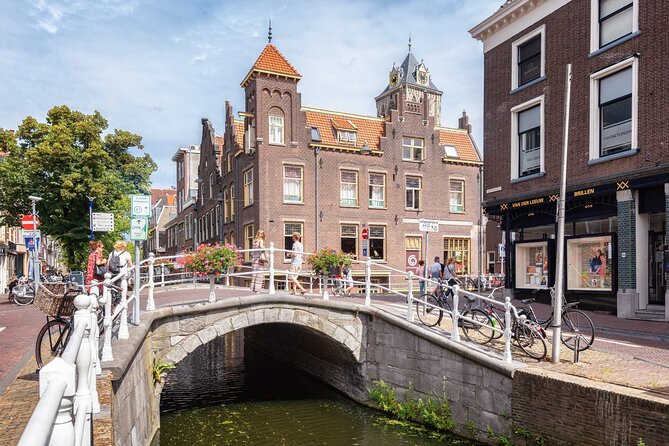
- Koornmarkt and the canal-street mindset
- Medisch Farmaceutisch Museum: history you may not expect
- The older church complex, Gothic details, and a Rijksmonument
- Delft’s Market square and the civic buildings around Nieuwe Kerk
- The tower clock and the bells of Francois Hemony
- Vermeer Centrum Delft and the St. Lucasgilde connection
- The Old Church’s origin story: charter city beginnings
- Prinsenhof: William the Silent’s residence and visible history
- De Roos windmill: finishing with Delft’s surviving mill
- Timing, pacing, and what to bring (so it feels fun)
- Who this escape game is best for
- Should you book this Delft escape game?
- FAQ
- How much does the Delft Blue’s Clues exploration game cost?
- How long is the experience?
- Do I need internet to play?
- Can I start at any time?
- Can I pause and resume the game?
- Is there a physical tour guide with you?
- Where do I start and where do I finish?
- Is it suitable for kids?
- Can I bring a service animal?
- Is it a private activity?
Key highlights worth planning for
- Offline-first smartphone gameplay means you can explore without data.
- Start anytime, play for about 1.5 hours, and it runs daily from midnight to late night.
- You hunt answers on location, looking closely at real Delft landmarks as you go.
- Group members can play free-of-charge on their own phones, making it easy to keep everyone engaged.
- Kids play free, and the “find the story by noticing details” style works well for families.
How an offline escape game changes Delft sightseeing
Delft can feel like a perfect postcard city, but that kind of view can also make you pass by interesting things too fast. This game flips the script. Instead of a straight line of photo stops, you move through Delft with a mission, and every stop asks you to look around and answer a challenge before moving on.
That approach is great for two reasons. First, you get a walkable flow between recognizable landmarks like Nieuwe Kerk and more niche stops like the Medisch Farmaceutisch Museum. Second, your brain stays switched on. When you are scanning doorways, facades, towers, and street corners for clues, you learn Delft in layers, not in a quick blur.
It is also genuinely practical. The game is available 24/7, so you are not tied to a fixed tour time. You can play solo or as a group, and you can pause whenever you want, which matters in a real city where coffee lines, weather, and detours happen.
Also flying a pennant in The Hague


Price and what you really get for $7.53
At $7.53 per person, you are not paying for a person with a clipboard. You are paying for an offline, self-paced puzzle route that stitches together multiple Delft highlights into one linked experience.
For me, the value comes from what is included:
- An app-based step-by-step experience that walks you through the route.
- No physical tour guide, so you keep control of pacing.
- Offline play, so you can explore more freely and avoid the hassle of hunting for signal.
- Mobile ticket access, which keeps things simple once you have the game ready.
- Free for kids, which can make this one of the cheaper ways to keep the whole family active.
The only “cost” you should account for is your attention. If you rush, you will miss clues. If you enjoy looking closely, you get a lot more out of the same route.
Starting at Oostpoort, where the clues begin
Your journey starts at Oostpoort 15, 2611 RZ Delft, at the eastern gate. This is not just a scenic archway. It is a brick Gothic survivor built around 1400, with later tower upgrades around 1510, including an added octagonal floor and high spires.
The game’s style here is smart: you do not get a passive readout. You have to look around and find the answer to the challenge that unlocks the next location. That means you slow down naturally, and you start training your eye to notice the kind of building details most people speed past.
A useful practical note: since this is an app-guided experience, take a minute at the start to make sure the game is loaded and you understand how to proceed. When your first clue depends on finding something on-site, a smooth start saves time.
Koornmarkt and the canal-street mindset
Next comes Koornmarkt, also tied to Delft’s canal world (the Corn Market area). Here, the challenge is still the same: look around and find what the game is asking for, then move forward.
What I like about this stop is that it trains you to read Delft like a city, not just a museum. Streets and canals are where Delft’s identity shows up: tight corners, historic layouts, and that distinctive canal-city rhythm. When you are scanning for clues here, you are also learning the shape of the neighborhood.
Potential drawback: if you are expecting big set-piece scenery at every turn, Koornmarkt can feel more subtle. The payoff is in noticing how the city works, not in expecting one dramatic landmark.
Medisch Farmaceutisch Museum: history you may not expect
One of the standout stops is Medisch Farmaceutisch Museum, a museum focused on antique medical and pharmaceutical instruments. This is a refreshing pivot from the usual “church and clock tower” itinerary style.
In a game like this, a museum stop can go two ways. It can either become a quick glance, or it can become an “aha” moment where you realize history is bigger than you thought. Here, the subject matter nudges you to think beyond architecture, into how people lived and treated illness in earlier centuries.
If you enjoy quirky, specific topics, you will likely get more satisfaction out of this stop than you would on a standard walking tour. If you only want visual landmarks, you might wish the clues gave even more time to explore. Still, the game’s push to look around helps.
Under the next bridge out of The Hague:
- The Hague: Madurodam Miniature Park Entry Ticket
★ 4.6 · 1,559 reviews - The Hague: Hop-on Hop-off Heritage Tram Tour
★ 4.5 · 1,311 reviews - The Hague: Escher in The Palace Museum Ticket
★ 4.6 · 896 reviews - The Hague: Scheveningen Beach RIB Speedboat Tour
★ 4.7 · 416 reviews
The older church complex, Gothic details, and a Rijksmonument
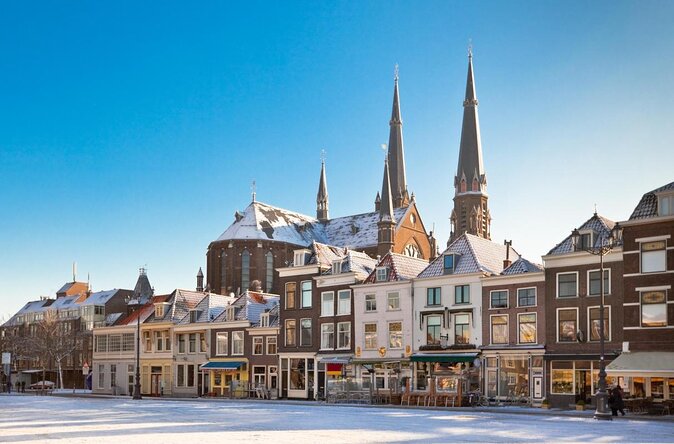
You also pass an old church built around 1400 in Gothic style, designated a Rijksmonument since 1967. The description you get as part of the experience is tied to location, too, noting it sits on the east side of the Oude Deft.
This is one of those places where Gothic architecture can look impressive but vague if you do not know where to focus. The game helps by forcing you to search for a challenge answer on-site. That can make details like shape, structure, and the building’s age feel more concrete.
What to consider: churches and historic buildings can have areas that are visually striking from the outside but harder to interpret from a distance. The game solves this by making the clue hunt your guide, but you still might want to pause and look from a couple of angles if the clue feels hard to spot.
Delft’s Market square and the civic buildings around Nieuwe Kerk
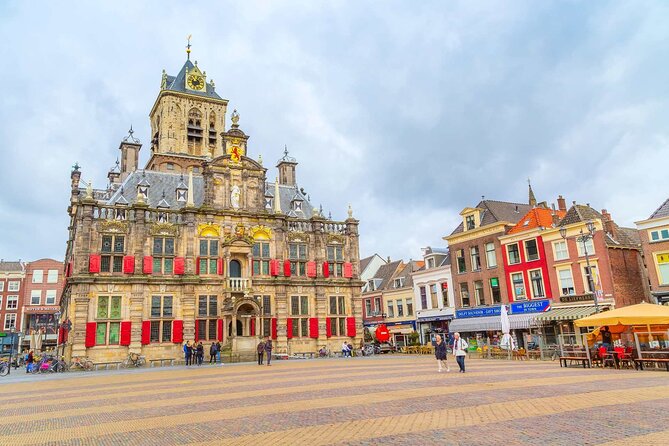
The walk then centers on the Markt, one of the largest historic market squares in Europe, measuring about 120 by 50 meters. It is almost rectangular, bordered on one side by the Nieuwe Kerk and on the other by Delft’s town hall.
The game’s clue prompts turn a big open space into something you can actually study. The Markt was set up on a raised ridge shaped by tidal influence from the channel called de Gantel, which helps explain why Delft’s city center has that distinctive elevated feel.
I like the way the game connects space to story. Even if you never remember the numbers later, the sense of why the place is where it is sticks with you, because you learned it while walking through it.
Then there is the city hall itself, described as Renaissance style and located across from Nieuwe Kerk. It is tied to civic life, including a known role as a venue for weddings, while administrative functions are said to be handled in an office inside the Delft railway station building. In other words, this square is not just about looks. It still functions.
The tower clock and the bells of Francois Hemony
Another key stop is the clock tower, with details you will not hear if you are just taking photos. The tower was built between 1396 and 1496 by Jacob van der Borch, who also built the Dom in Utrecht. There is even mention of a monument for Hugo de Groot created in 1781.
The mechanical clock part is especially fun: it includes 18 bells by Francois Hemony from 1659, plus 30 modern bells. That combination is a reminder that historic doesn’t mean frozen in time. Delft’s landmark features mix older craftsmanship with later updates.
How the game helps you here: since the challenge requires you to look around, you naturally scan for architectural cues and clock-related specifics, rather than treating the tower like a background prop.
Vermeer Centrum Delft and the St. Lucasgilde connection
At Vermeer Centrum Delft, you are given a historical layer beyond “this is where they talk about Vermeer.” The building was once home to the St. Lucasgilde, a guild of painters and glass makers in the 17th and 18th centuries, and Vermeer joined in 1653. Saint Lucas is identified as the patron saint of painters.
This is exactly the kind of detail that makes a self-guided experience feel smarter than a simple audio narration. When you know the guild connection, the building stops being a generic stop and starts being part of a creative ecosystem.
You still have the same game mechanic: look around for the clue answer, then continue. That keeps you from skipping the “why this place matters” part.
The Old Church’s origin story: charter city beginnings
You also encounter the Old Church, described as founded in 1246, when Count William II granted Delft its own charter. Back then, the church was named after St Bartholomew, the patron saint tied to the founder. Over later centuries, it grew into an impressive gothic basilica.
This is where the game’s structure becomes more than entertainment. You are walking the city while learning its timeline. The 1246 origin detail helps you understand Delft as a place that had authority and structure early, not just a pretty place that happened to survive.
Potential drawback: if you are in a rush, it can be tempting to skim the descriptions and move on. With this game, taking even a few extra seconds to orient yourself makes the story land better.
Prinsenhof: William the Silent’s residence and visible history
The Prinsenhof is an urban palace built in the Middle Ages as a monastery. Later, it served as a residence for William the Silent, and he was murdered there in 1584. The description includes a detail you can actually spot: holes in the wall made by bullets at the main stairs are still visible.
This is one of those stops where a clue hunt makes real history feel immediate. You are not only learning the event, you are prompted to look around in the exact area tied to that moment.
If you like historical specificity, Prinsenhof is likely to be one of your favorite parts of the game. It is also a stop where you might want to slow down, because the story is darker than it looks from a distance, and that affects how you experience the space.
De Roos windmill: finishing with Delft’s surviving mill
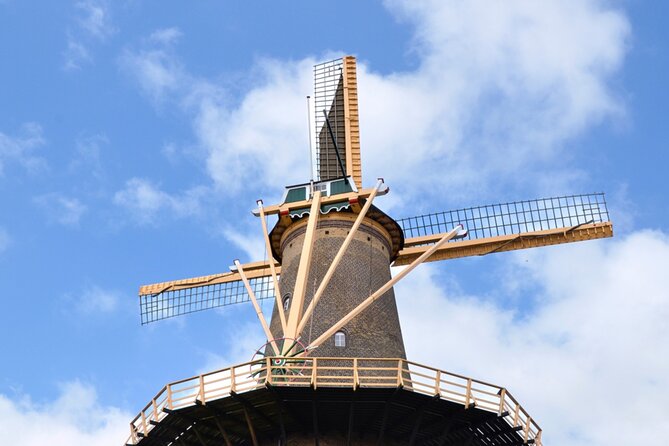
Your walk ends at Delft Windmill de Roos on Phoenixstraat 111, 112, 2611 AK Delft. The windmill, called de Roos (The Rose), was built in 1679 for grinding corn. The first mention of a mill at this location goes back to 1352.
Even better, de Roos is described as the only remaining windmill of fifteen that once stood in the Delft region. That detail makes the ending feel meaningful. You are not just closing a game. You are arriving at something rare.
If you want a satisfying finish line for your puzzle route, this is it. Windmills are the kind of landmark that look great in photos and also carry a clear purpose story. Finish here and you are likely to remember the route more than you expect.
Timing, pacing, and what to bring (so it feels fun)
The experience is about 1 hour 30 minutes (approx.). That is a sweet spot. Long enough to link multiple landmarks, short enough that it does not drain your whole day.
Because the game is permanently available from midnight to 11:30 PM, you can fit it around museum hours or a light meal. And because you can pause and resume, you can handle real life without derailing the plan.
What I recommend bringing:
- A smartphone with the app ready for offline play.
- A charged battery, since you are using step-by-step guidance outdoors.
- Comfortable walking shoes, since you are moving through historic streets and between several points.
Who this escape game is best for
This works especially well if you:
- Prefer independent travel with a structure that still leaves you flexibility.
- Like puzzles and learning by noticing, not by sitting through a lecture.
- Want an active family-friendly activity, with free play for kids.
- Are traveling with friends or relatives and want everyone to participate on their own phone.
It might be less ideal if you want a classic guided talk, because there is no physical tour guide. It also could frustrate you if your phone access to the game is flaky, since the route depends on the app.
Should you book this Delft escape game?
Yes, I would book it if you want a practical, low-cost way to see Delft with a brain-on approach. The offline setup, the ability to start any time, and the fact that the route touches everything from gates and churches to Vermeer-related guild history and the de Roos windmill make it a strong value for the time you spend.
Just do one thing before you wander too far: make sure your access works in the app. If it does, this is the kind of activity that turns familiar Delft landmarks into something you actually remember. If it does not, use the app support channel or email [email protected] so you can get running quickly.
FAQ
How much does the Delft Blue’s Clues exploration game cost?
The price is listed as $7.53 per person.
How long is the experience?
It takes about 1 hour 30 minutes (approx.).
Do I need internet to play?
No. The game can be played offline, so you do not need an internet connection while exploring.
Can I start at any time?
Yes. You can start at any hour, and the experience is available 24/7 every day of the year.
Can I pause and resume the game?
Yes. You can pause whenever you like and resume later.
Is there a physical tour guide with you?
No. It is an app-based experience with step-by-step guidance, not a physical tour guide.
Where do I start and where do I finish?
Start at Oostpoort 15, 2611 RZ Delft, Netherlands. The end is Delft Windmill de Roos, Phoenixstraat 111, 112, 2611 AK Delft.
Is it suitable for kids?
Kids play free.
Can I bring a service animal?
Yes. Service animals are allowed.
Is it a private activity?
Yes. It is described as a private tour or activity, so only your group will participate.
Latest to arrive along the quays of The Hague
The Hague Tours & Experiences, compared.



Royal Delft: Delftblue Factory and Museum Admission Ticket
Read our review →Browse the lists this tour appears in