

Reviewed · THE HAGUE TOURS & EXPERIENCES
Highlights walking Tour in Delft with Audio and GPS Guide
Follow Delft by phone, no map needed. This audio and GPS walk is built around key historic stops, from an artist home to the Prinsenhof. I like that the GPS tracks your location and helps with direction changes, and I like the hands-on style of the museum learning, especially around Vermeer.
Here’s the catch. One downside is that the tour content can feel a bit thin and low on big-picture context, so you may need to lean in with your own curiosity. If you stop at everything and stay engaged, it can still be a nice way to orient yourself in Delft.
In This Review
- Key things I’d focus on before you go
- Why this Delft audio GPS walk can be a great use of 2 hours
- Getting to the start at Museum Paul Tétar van Elven in Delft
- Stop by stop in Delft: from an artist’s preserved home to beer wealth
- Vermeercentrum and the pigments lesson you will remember
- Hugo de Groot and William of Orange, told through statues and specifics
- Koornbeurs and the Blue Heart: Delft’s commercial past and modern touch
- Value and pacing: how to get the most from a 2-hour route
- Price and who should book this audio GPS walk
- Should you book it? My take
- FAQ
- How long is the Delft walking tour?
- What is the price per person?
- Is the tour offered in English?
- Does the tour use GPS and audio?
- Where do I meet for the tour?
- What time of day can I start?
- Is this tour private?
- Are service animals allowed?
- Is there public transportation nearby?
- Is free cancellation available?
Key things I’d focus on before you go
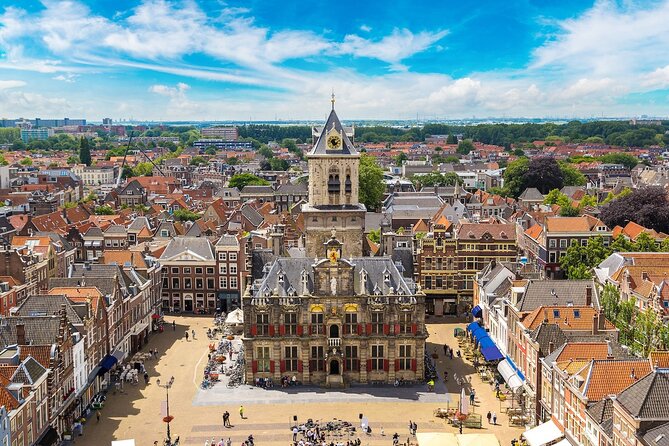
- GPS that places you correctly at each stop so you do not wander or second guess the route
- Delft Blue and Vermeer pigments themes that connect art to real materials
- The Orange story at the Prinsenhof with clear names and a specific date
- Beer-powered wealth made visible through hop decorations on a medieval building
- Courtyard history in two layers from post-explosion rebuilding to later poor residents’ housing
Why this Delft audio GPS walk can be a great use of 2 hours
This tour works best as a “get your bearings fast” stroll. Delft is compact, but it still helps to have someone connect the dots for you. The setup here is audio plus GPS, which means your phone acts like a silent guide that knows where you are.
The best part, in practical terms, is the GPS behavior. The route is tied to key points, and the guidance adjusts as you move. That is a big deal in a place where a wrong turn can cost time, especially if you are trying to hit multiple stops before you run out of daylight.
The biggest consideration is content depth. The route sounds like it hits the right locations, but the storytelling can feel more like brief notes than a fully framed narrative. Think of it as a tour that points you at the sights and adds useful facts, not one that gives you a long, flowing lecture.
So, plan it as orientation plus highlights. If you want thick context at every corner, you might pair this with one deeper museum visit later.
More Guided Walking Tours in The Hague

Getting to the start at Museum Paul Tétar van Elven in Delft
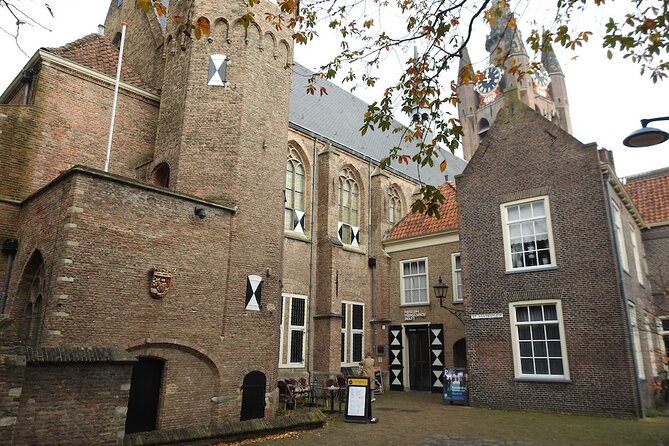
The meeting point is Museum Paul Tétar van Elven at Koornmarkt 67, 2611 EC Delft. The tour ends back at the same place, which makes it easy to build into your day.
One important detail: the listing location shows The Hague, but the actual walking route is clearly in Delft. Delft is close enough to be a common day-trip from The Hague, so this mismatch is likely just how the product is categorized. Either way, show up at the Delft meeting point.
You can start any day during the broad window of 7:00 AM to 7:00 PM (with dates listed through 2027). Since your tour length is about 2 hours, the late morning to early afternoon slot usually gives you the best balance of comfortable walking and museum timing.
Stop by stop in Delft: from an artist’s preserved home to beer wealth
The walk begins at the Paul Tétar van Elven museum, which is located in the home of a 19th-century painter and collector. This is one of those places where the “museum” concept is not just about objects. It is also about atmosphere. The interior was preserved based on the founder’s wishes, so you get the sense of walking into a time capsule of his tastes. If you like interiors, decor, and how people actually lived, this stop is a strong opener.
Next comes the Gemeenlandshuis, described as the oldest house in Delft dating to the early 1500s. The key idea here is wealth from beer. In a time when water quality was poor, beer was consumed frequently. Jan de Huyter, a tenant connected to hops, reportedly built a fortune, and the building still carries hop references on its facade. You also get a Gothic high stepped gable meant as a status symbol and lookout tower. Even if you never look up at the roofline on your own, the audio guidance should nudge you to notice it.
Then you move to the Prinsenhof Museum, a big pivot point in the story of the Netherlands. This stop is famous because William of Orange was shot dead on 10 July 1584 by the Frenchman Balthasar Gerards. The site was once the Sint Agatha monastery, and it is recognized among the National Service for the Preservation of Monuments from 1990. The museum theme also connects several threads: Delft Blue, major Delft thinkers like Hugo de Groot and Antoni van Leeuwenhoek, and Golden Age collections such as paintings, pottery, and utensils.
If your phone app gives you only light commentary here, do not worry. Even the exterior and the monument markers around the Prinsenhof can still land emotionally. A specific assassination date is the kind of fact that makes history stick.
After that, the route turns toward everyday life through the courtyards called hofjes. First is Hofje van Gratie, a courtyard for elderly residents. The background is shaped by disaster and rebuilding. Delft experienced a major gunpowder explosion, and later planning created new courtyard housing once space opened up. The description includes how these homes were arranged, with buildings facing the street, and a gallery at the rear that held practical areas like kitchens and washing.
What I like about this stop is that it takes you beyond famous battles and big names. You get housing design and living patterns, plus how the community responded to catastrophe.
The story extends again into a later version of the courtyard built from the estate of Elisabeth Pauw, daughter of mayor Jacob Pauw. Her husbands were also mayors in the Dirck van der Dussen and Johan van der Dussen lines. The courtyard was intended for poor people and consists of 8 houses in two rows of four around a square. Today it is used for people with mental or multiple disabilities. That present-day detail gives the architecture a real purpose, not just a postcard past.
Vermeercentrum and the pigments lesson you will remember

The Vermeercentrum is the largest museum focused on Johannes Vermeer. This is a great stop if you care about how art is made, not only what art looks like. The tour setup points you toward understanding the pigments Vermeer used and how his paint was made.
That matters because Delft is not just scenic streets and canals. This city also produced artists and methods. If you find yourself bored by purely narrative tours, this stop gives you a more concrete “how it worked” lens.
You can think of the Vermeercentrum as the artistic counterweight to the political intensity at the Prinsenhof. Orange and Gerards are about power and violence. Vermeercentrum is about craft. Together they make Delft feel less one-note.
Hugo de Groot and William of Orange, told through statues and specifics
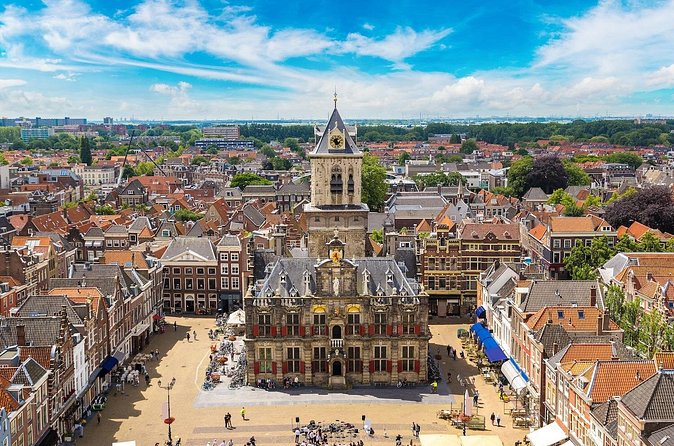
After you move past the museums and courtyards, you hit two statue moments that tie the tour’s names together.
First is the statue of Hugo de Groot. He was born in Delft in 1583 and was a jurist and writer. The tour notes his work across different genres, from Latin tragedies and poems to theological treatises and Dutch poems. The key idea is his most important work in history and law, especially the law of war and peace, which forms a basis for modern international law. Even if you are not a law nerd, this is a strong “Delft influenced the world” connection that goes beyond the obvious artists.
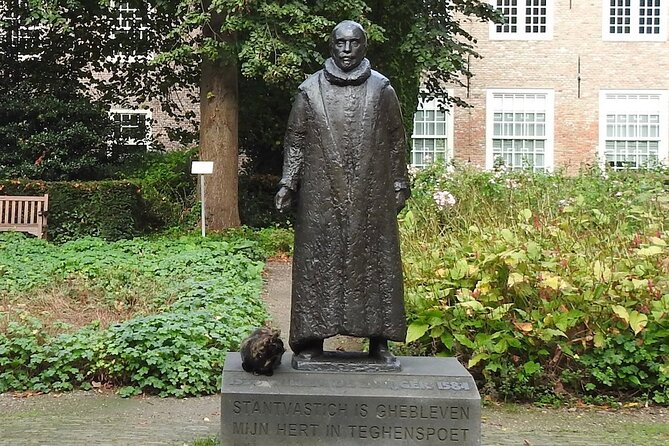
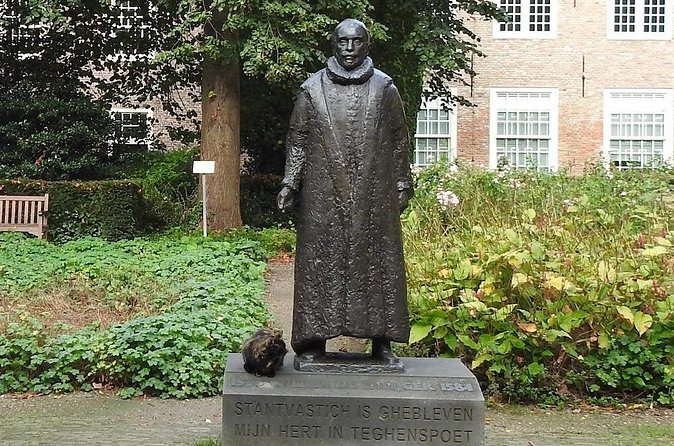
Then comes the statue of William of Orange, known in the Netherlands as the Father of the Fatherland. His name includes Prince of Orange, a title he inherited in 1544. The date 10 July 1584 returns here because Balthasar Gerards shot him on the steps of the Prinsenhof. The audio context also explains that Gerards received a reward from King Philip II of Spain, who accused Orange of high treason.
If your goal is to leave Delft understanding why it matters historically, these statue stops help you anchor the theme. The tour’s facts are specific enough to stick.
More gables counted on foot:
- The Hague: Courtyard Walking Tour
★ 4.5 · 71 reviews - Walking Tour of Delft – The City of Orange and Blue
★ 5.0 · 50 reviews - Private Walking Tour of Delft: Dive into the Dutch Golden Age
★ 5.0 · 33 reviews - The Hague Private Walking Tour with a Local
★ 4.0 · 29 reviews
Koornbeurs and the Blue Heart: Delft’s commercial past and modern touch
The Koornbeurs is a national monument that began in 1295. The idea is trading infrastructure. Stone cellars were for meat storage, and wooden halls above were used for trade. After a great city fire, those wooden structures were lost and later rebuilt in 1650, then again in stone. In 1871, the Koornbeurs name was established for this building, and it has had multiple purposes since then.
This stop is valuable because it shows Delft as a working city, not only a museum town. If you like architecture with a practical story, Koornbeurs gives you that.
Finally, there is the Blue Heart by artist Marcel Smink. It is a contemporary artwork built to relate to the historical surroundings. The technical construction references the Technical University, the blue ties to Delft blue, and the heart is meant to represent the city. It is a quick modern moment near the historic core, and it is useful as a reminder that Delft did not stop at the Golden Age.
Value and pacing: how to get the most from a 2-hour route
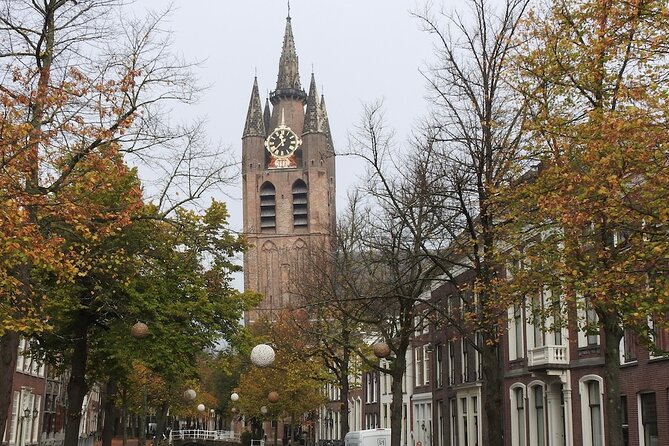
The duration is about 2 hours, and the tour includes travel time in that total. That suggests a fairly brisk pace, with time spent at stops rather than long museum wandering.
If you want to match the route’s intended pacing, do this: treat each stop as a 5 to 8 minute stop unless you feel pulled in. Start with the three anchors: Paul Tétar van Elven, the Prinsenhof area, and Vermeercentrum. Those give you the biggest “experience return” for Delft’s identity.
Then, scan the rest. Hofje van Gratie, Koornbeurs, Hugo de Groot, William of Orange, and Blue Heart are great for quick context and visual variety. Even with a lighter app narrative, the places themselves carry meaning.
Also, remember the format reality. One key warning from the experience is that the app can guide you well but may not provide much overall context. So if you are the type who reads every little plaque, you might still be happy. If you want story heavy content, you may feel underfed unless you already know a little about Delft.
Price and who should book this audio GPS walk
At $8.41 per person, this is priced like an impulse-friendly way to cover ground without committing to a long guided group tour. The value is best if you:
- want a short route through Delft’s must-see locations
- like to learn facts in small chunks while walking
- do not want to manage a paper map
It is also listed as English language. The tour is private, meaning only your group participates. That is good if you prefer quiet pacing and fewer people around you.
One more practical point. Service animals are allowed, and the meeting point is near public transportation, which makes it easier to fit into a day.
Should you book it? My take
I think this is a good booking if you treat it like a GPS-assisted orientation walk with strong location choices. The GPS navigation is the clear strength, and the route hits major Delft themes: art homes, beer wealth, the Prinsenhof and the Orange story, and Vermeer materials through the Vermeercentrum.
I would not call it a strong choice if you want deep storytelling at every step. The app can be accurate with where you are, but the content may feel sparse and light on big-picture framing.
If you are visiting Delft for the first time and you want a simple way to structure your time, book it. If you already planned museum time and you want a talk-heavy guide, you might spend that money on something more narrative.
FAQ
How long is the Delft walking tour?
It runs about 2 hours.
What is the price per person?
The price is $8.41 per person.
Is the tour offered in English?
Yes, it is offered in English.
Does the tour use GPS and audio?
Yes, it is described as an audio and GPS guided walking tour.
Where do I meet for the tour?
You start at Museum Paul Tétar van Elven, Koornmarkt 67, 2611 EC Delft, Netherlands, and the tour ends back at the meeting point.
What time of day can I start?
The listed opening hours are 7:00 AM to 7:00 PM, Monday through Sunday.
Is this tour private?
Yes. Only your group participates.
Are service animals allowed?
Yes, service animals are allowed.
Is there public transportation nearby?
Yes, it is near public transportation.
Is free cancellation available?
Yes. You can cancel up to 24 hours in advance for a full refund.
If you tell me what day you’re going and whether you prefer museum interiors or more street-level viewing, I can suggest a good pacing plan for your exact timing.
More Self-Guided Tours in The Hague
- Discover The Hague with a self-guided Outside Escape city tour★ 4.5 · 35 reviews
- Discover Delft with a self-guided Outside Escape city game tour!★ 5.0 · 32 reviews
- e-Scavenger hunt Delft: Explore the city at your own pace★ 4.5 · 26 reviews
- Hague: The Heart of Old Town Exploration Game and Tour★ 3.5 · 25 reviews
More Audio Tours in The Hague
- The Hague Scavenger Hunt and Highlights Self Guided Audio Tour★ 3.5 · 8 reviews
- The Hague: City Walk Audio Guide in 7 Languages on your Phone★ 3.5 · 5 reviews
- Delft: City Walk with Audio Guide in 7 Languages on your Phone★ 5.0 · 4 reviews
- The Hague Self-Guided Audio Tour★ 5.0 · 3 reviews
Latest to arrive along the quays of The Hague



The Hague Tours & Experiences, compared.





Royal Delft: Delftblue Factory and Museum Admission Ticket
Read our review →Browse the lists this tour appears in