
Reviewed · ROTTERDAM TOURS & EXPERIENCES
Rotterdam & Delft Private Offshore Daily Walking Tour
Rotterdam and Delft on foot can feel like a long day, not a long lecture. This private tour stitches together big city architecture, river views, and Delft blue ceramics into one 7.5-hour walk with short, manageable stops. It also starts at the Port of Rotterdam, which makes it especially handy if your trip is built around a cruise schedule.
I especially love how the route gives you smart contrasts, from Rotterdam Centraal’s modern station to Delft’s historic church towers and royal sites. I also like the way the tour works for real humans, with frequent breaks, quick orientation stops, and a guide who can adjust based on your interests and mobility needs (and yes, that part showed up in how Alex helped one group). One possible drawback is the cost adds up at a few paid stops, and you’ll also want to budget for public transportation during the day.
In This Review
- Key Points That Matter Before You Go
- Price and Logistics: How Much This Costs, and What You Get
- Kicking Off at Rotterdam Centraal: Modern Rails and Heavy Daily Traffic
- Rotterdam’s Water Power Stop: The Building That Managed Life by Water
- Grote of Sint-Laurenskerk: A Late Gothic Church With War Survival Credibility
- Erasmus Monument and the Erasmus Thread: Rotterdam’s Thinker in Stone
- Markthal and the “Sistine Chapel of Rotterdam” Market Hall Moment
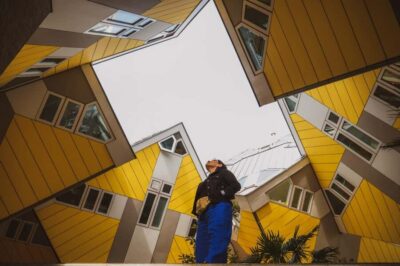
- Cube Houses: Short Stop, Real Wow, Included Entry
- Oude Haven and Witte Huis: Medieval Port Life Meets Post-Disaster Survival
- Bridges: Willemsbrug, De Hef, and De Boeg Make the River the Main Character
- Leuvehaven to Erasmus Bridge: Shipping Culture, Then Rotterdam’s Signature “Harp”
- Switching to Delft: Station Delft, Ceramics, and Old Meanings of New Space
- Girls Orphanage, Microscope Memory, and Delft’s Water Management Buildings
- Archives and Prinsenhof: From Latin School to Revolution Aftermath
- Begijnhof Area and Old Church: The City That Tilts and the Order That Endures
- Delft City Hall and the Vermeer Information Point: Dutch Pride With a Side of Paint Chemistry
- Hugo de Groot and New Church: Legal Humanism Meets Royal Final Rest
- Maria van Jessekerk and Royal Delft: Faith on One Side, Ceramics on the Other
- Timing and the Pace: Why This Tour Works in 7.5 Hours
- What You’ll Pay Extra For, and How to Plan It
- The Human Factor: Why Alex’s Approach Changes the Day
- Should You Book This Rotterdam and Delft Private Walking Tour?
- FAQ
- What is the duration of the Rotterdam and Delft private walking tour?
- How many people are in the group?
- What is included in the price?
- What entrance fees are not included?
- Is pickup available, and where does the tour start?
- Is there public transportation during the tour, and is it paid separately?
Key Points That Matter Before You Go

- Small group, big flexibility, max 4 travelers, with a guide who adjusts the pace and focus.
- Port-to-city feel, meeting at the Port of Rotterdam and returning there at the end.
- A mix of free and paid sights, with Cube Houses entry included and several other indoor sites priced separately.
- River reading lesson, lots of bridges, memorials, and harbor landmarks built for easy photos and orientation.
- Delft blue culture stops, including the station area and Royal Delft (entry not included).
- English mobile tour flow, with a mobile ticket and a schedule running daily from late March through February.
Price and Logistics: How Much This Costs, and What You Get
This is priced at $5,683.71 per group for up to 4 people. If you book a full group, that works out to about $1,420 per person. That’s not cheap, but you are buying privacy, pace control, and a guide who can adapt when plans go sideways, as shown by Alex escorting a traveler by train when luggage was delayed and then coordinating the return around a cruise day.
Also, the schedule is set for Monday through Sunday, 9:00 AM to 6:00 PM. The tour duration is listed as about 7 hours 30 minutes, and travel time is already included in that total. One thing I’d keep in mind: you’re walking plus some transit, and public transportation is listed as €10 per person, so it’s worth building that into your day-one budget.
Finally, the meeting point is very specific: Port of Rotterdam, Wilhelminakade 909, 3072 AP Rotterdam. Pickup is offered in any hotel in Rotterdam or Delft. If you’re coming from Amsterdam, the details say pickup can be arranged at Amsterdam Passenger Terminal, Amsterdam Central, or other agreed locations.
More Guided Walking Tours in Rotterdam



Kicking Off at Rotterdam Centraal: Modern Rails and Heavy Daily Traffic
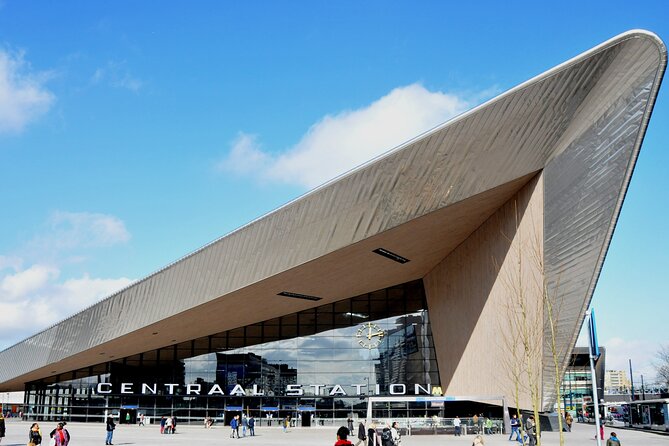
The day starts at Rotterdam Centraal Station. You get about 10 minutes here, which is just enough time to clock the scale and the sleek architecture before you move on. It’s the main railway station for Rotterdam, with an average of 170,000 passengers per day, so it’s not a quiet postcard moment. It’s the real beating heart of how people flow through the city.
Look for how the station signals Rotterdam’s identity: practical, modern, and built to handle movement. If you like cities that feel engineered rather than decorative, this stop hits fast. The one consideration is that, with such heavy daily foot traffic, you might want to keep an eye on timing if you’re arriving right at the start.
Rotterdam’s Water Power Stop: The Building That Managed Life by Water
Next is Hoogheemraadschap Schieland and Krimpenerwaard, another 10-minute stop. This is a 17th-century building tied to water policy and management in South Holland, including the water authority that once had Napoleon Bonaparte staying there temporarily.
Why this matters: Rotterdam and the Netherlands make sense only when you understand water management. You’re not just seeing pretty buildings, you’re getting a key to the city’s logic. If you’re the type who loves why-history-behind-the-walls, this is a strong orientation pause, even if you don’t go inside.
Grote of Sint-Laurenskerk: A Late Gothic Church With War Survival Credibility
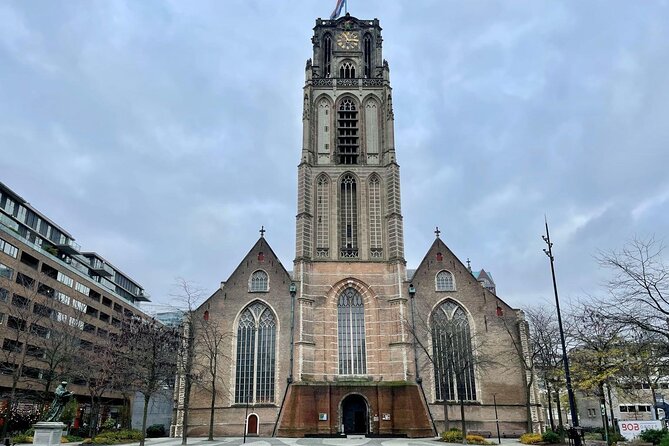
Then you’ll spend 10 minutes at Grote of Sint-Laurenskerk. This late Gothic church dates to 1525 and is described as the oldest building in Rotterdam. It also survived Nazi bombing on May 15, 1940, which gives the building a serious gravity beyond architecture.
You may choose not to pay an entry fee here since it’s listed as Not included, but even an outside look can be powerful. The drawback to flag: with so many sites on the schedule, it’s easy to feel like you’re “just passing,” so decide in advance whether you want inside time at the paywalled stops.
Erasmus Monument and the Erasmus Thread: Rotterdam’s Thinker in Stone
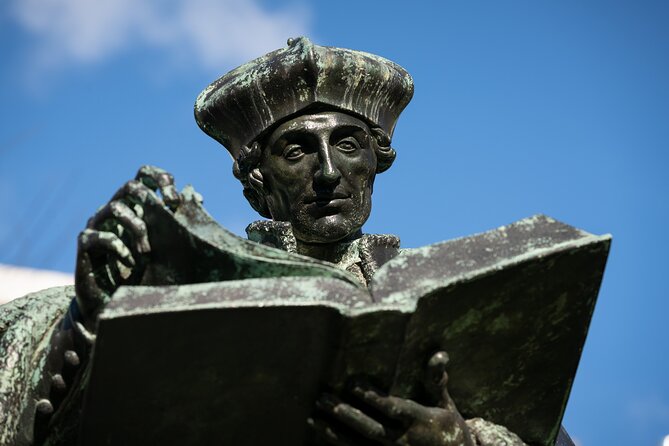
At Erasmus Monument, you’ll get 10 minutes, and it’s a free stop. This monument honors Desiderius Erasmus of Rotterdam, one of the major philosophers and scholars of the 16th century. The point of this stop is easy: Erasmus shows up in names of buildings and education institutions, so you start seeing the city’s intellectual branding.
If you like walking tours that connect people to place, this works well because it sets a theme. Rotterdam is not only ships and bridges, it’s also scholarship and influence.
More Private Tours in Rotterdam
- Rotterdam in half a day: All-inclusive, Authentic private Tour of Rotterdam
★ 5.0 · 146 reviews - All-Inclusive Private Windmill Tour to Kinderdijk from Rotterdam
★ 4.5 · 59 reviews - Rotterdam: Private Walking Tour with a Local
★ 4.8 · 49 reviews - Private Pedicab/Rickshaw Tour of Rotterdam With a Local Guide
★ 4.5 · 47 reviews
Markthal and the “Sistine Chapel of Rotterdam” Market Hall Moment
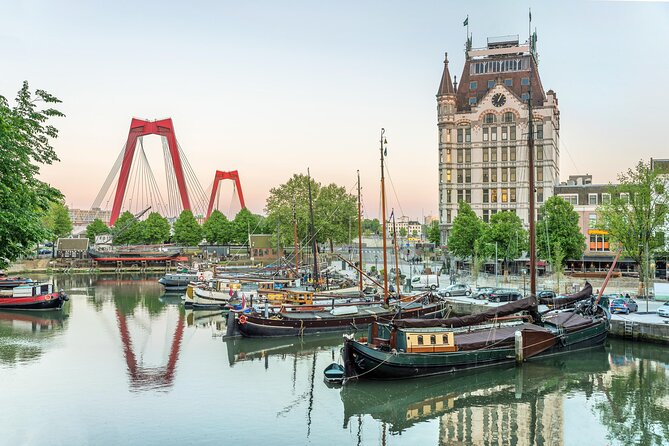
Next is Markthal, about 15 minutes, and it’s free. This is a modern horseshoe-shaped market hall with living spaces built in, and it’s often nicknamed The Sistine Chapel of Rotterdam.
Even if you don’t plan to eat there, it’s worth stopping because it shows how Rotterdam repurposes space. A huge food and market hub also becomes a visual centerpiece, and you get that without paying an entry fee. The only practical note: market halls attract crowds, so keep your phone ready and your meeting point clear if you go inside briefly.
Cube Houses: Short Stop, Real Wow, Included Entry
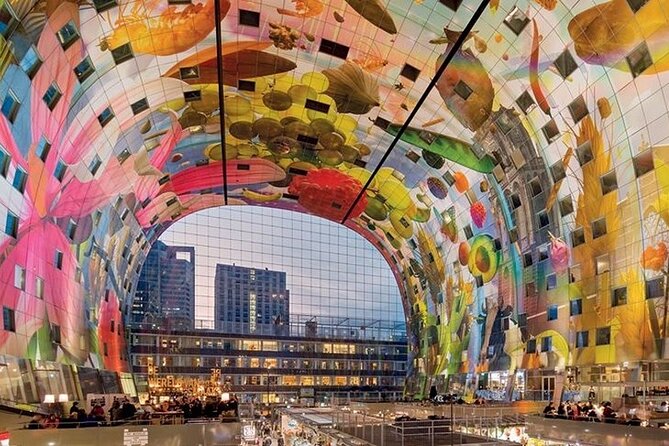
At Kijk-Kubus, you’ll spend about 20 minutes and the entry is included. These are the cube-shaped apartment structures perched atop supporting columns, designed so that only about 3/4 of the inner space is usable.
This is one of the tour’s best “see it, understand it” moments. You look, you notice the shape, and you immediately grasp the tradeoff built into the design. If you’re doing this because you like modern design experiments, you’ll be glad this one is covered without extra fees.
Oude Haven and Witte Huis: Medieval Port Life Meets Post-Disaster Survival
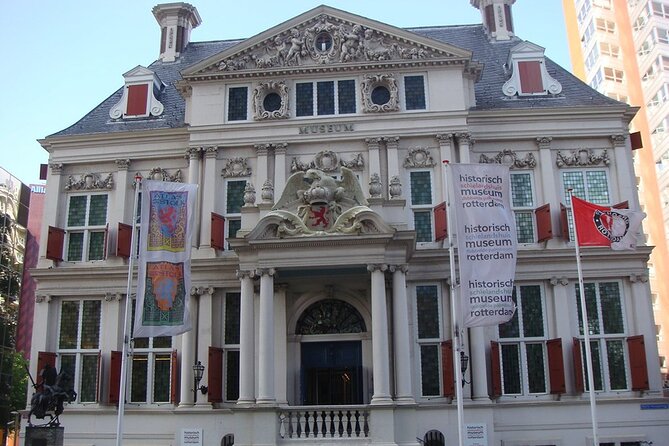
Then it’s Oude Haven, a 20-minute stop and free. It’s one of Rotterdam’s older ports, linked to the former mouth of the River Rotte to the Nieuwe Maas. Today it’s a favorite hangout area with coffee bars, restaurants, and taverns.
After that, Witte Huis gets 10 minutes and it’s also free. It was once described as the highest “skyscraper” in Europe and is listed as one of the rare buildings that survived bombing on May 14, 1940.
Put these together and you get Rotterdam’s rhythm: old infrastructure and modern ambition side by side, with survival stories built into the skyline. The drawback is emotional fatigue. If war-story details start to pile up, focus on what the buildings look like and how they’re used now.
Bridges: Willemsbrug, De Hef, and De Boeg Make the River the Main Character
You’ll cross the city using river landmarks. Willemsbrug is about 10 minutes and free, also called the Red Bridge, dedicated to Willem III. It connects central and northern parts of Rotterdam to southern districts.
Next is De Hef, another 10 minutes stop and free. This steel construction called The Lift used to serve as a rotating and lifting train bridge across the Nieuwe Maas before the rail tunnel existed.
Then comes De Boeg, about 10 minutes, also free. This is a war memorial on the river embankment commemorating 3500 people on board Dutch merchant ships who died in World War II.
I like this sequence because you’re not just looking at bridges, you’re reading them. Each bridge is a different answer to how Rotterdam moves people and honors loss. If you want photos, this is where you get them, because every stop is positioned by water.
Leuvehaven to Erasmus Bridge: Shipping Culture, Then Rotterdam’s Signature “Harp”
Leuvehaven is a 20-minute free stop and described as an open-air maritime museum. The collection includes steamships, docking cargo machines, ship engines, and equipment connected with navy and shipping from the mid-19th century into the 1970s.
This gives depth to the harbor story you’ve been walking through. It’s also an easy stop to take at your own pace since the outdoor setting is forgiving.
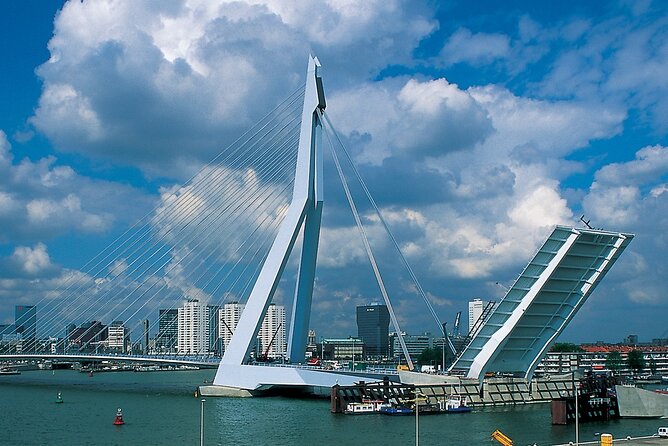
Finally, you’ll reach Erasmus Bridge, about 15 minutes and free. This hanging bridge is listed as the youngest bridge in Rotterdam and one of the city’s best-known symbols, also called the Swan or The Harp. It’s described as 139 m high, with the biggest and heaviest opening part in Europe at 80 m long.
This is a great “reset” moment. You’ve been learning the city’s past. Now you see the city’s brand in metal and angles.
Switching to Delft: Station Delft, Ceramics, and Old Meanings of New Space
After Rotterdam, you roll into Delft. Your first stop there is Station Delft, about 10 minutes, free. It’s an energy sustainable underground station with a new city hall above, and the area includes a retrospective of Delftware blue ceramics and history.
If you like city design that explains itself, this is a smart bridge between places. Delft isn’t presented as a museum only. It’s presented as a working town with layers.
Girls Orphanage, Microscope Memory, and Delft’s Water Management Buildings
Next comes Sociëteit het Meisjeshuis, a 10-minute free stop. This girls’ orphanage dates to 1578 and served until the 1950s.
Then the Netherlands Cancer Institute (NKI) appears as a 10-minute free stop. It includes a monument connected to a Delft citizen described as a trader and scientist, linked to the founder of the microscope.
After that, you’ll see Gemeenlandshuis van Delfland, about 10 minutes, free. It’s a historic early 16th-century building and described as the headquarters of local water management organization since 1645.
This cluster might feel unexpected at first, but it makes sense if you think like a local: Delft’s identity is built from practical institutions, not only art and churches. It’s also a nice change from tourism-only stops, since these places speak to civic life.
Archives and Prinsenhof: From Latin School to Revolution Aftermath
Your next stop is Stadsarchief Delft, about 10 minutes, free. It’s described as the former Latin language school and military barracks, now the city archive.
Then it’s Museum Prinsenhof Delft, listed as 20 minutes, and the entry is Not included. The stop is tied to the Geertruyie van Oosten monument and it also mentions Prinsenhof as residence, headquarters, and the place of death of assassinated revolutionary leader Willem The Orange.
Key practical point: because the Prinsenhof entrance fee is €14 per person and the tour marks it as not included, you’ll want to decide quickly whether inside time matters to you. You still get value from the outside focus, but this is one where pay-or-skip becomes a real choice.
Begijnhof Area and Old Church: The City That Tilts and the Order That Endures
Next you’ll stop at Bagijnhofpoort, about 10 minutes and free. This area is described as a port and memorial dedicated to the Beguines, a semi-closed religious order similar to nuns.
Then comes Old Church, about 15 minutes, and Not included. It’s often called the Delft version of a leaning tower, with the tower described as leaning about two meters from vertical. It’s the oldest church in Delft from 1246, with a 75 m tower.
The Old Church is famous, but the practical consideration is cost and time. The listed entrance fee is €8 per person, and you’ll want to weigh that against other paid stops later in the day.
Delft City Hall and the Vermeer Information Point: Dutch Pride With a Side of Paint Chemistry
Next is Stadhuis Delft (former city hall from 1620), about 15 minutes, free. It sits in one of Delft’s market-area hubs, which helps you understand why the square mattered historically.
Then Vermeer Centrum Delft appears as a 15-minute stop, Not included. It’s an information point about the painter’s work, style of painting, meaning of paints, and personal life.
That fee is listed as €12 per person. If you plan to spend extra on art context, this is a smarter use of money than paying only for the most famous building. If you’re not that into painting details, you can still enjoy the architecture and keep going.
Hugo de Groot and New Church: Legal Humanism Meets Royal Final Rest
You’ll get 5 minutes at Hugo de Groot Monument, free. It honors a Dutch philosopher, jurist, humanist, writer, diplomat, and founder connected with international law.
Then it’s New Church, about 20 minutes, Not included. The description calls it the funeral place of Willem The Orange and members of the Dutch royal family, with a height of 108 m and listed as the second highest sacral building in the Netherlands. The entrance fee shown is €15 per person.
This is a big-ticket emotional stop. Even if you skip entry, knowing it’s tied to royal and national endings changes how you look at it.
Maria van Jessekerk and Royal Delft: Faith on One Side, Ceramics on the Other
Next is Maria van Jessekerk, about 10 minutes and free. It’s a 19th-century Catholic church.
Then the tour ends with Royal Delft – Koninklijke Porceleyne Fles, about 30 minutes. The stop is not included, and the entry fee is not listed in the details you gave, so plan to expect a charge if you want inside time. This is where the tour points you toward the blue-ceramics story, including workshop, exhibition, and selling.
If you like buying something that feels tied to place, this is the obvious souvenir stop. If you don’t want to shop, you can still treat it as a final “how it’s made” culture checkpoint.
Timing and the Pace: Why This Tour Works in 7.5 Hours
With a 7 hours 30 minutes day, the structure matters. Many stops are only 10 minutes, and a few stretch to 15 to 20 minutes. That means you get a clear rhythm: look, orient, move, repeat.
For me, the best sign this tour won’t feel like a slog is how many sites are free and quick. You can enjoy the walk and keep your paid decisions focused on the places you care about most, like Cube Houses (included) and the main fee-based interior stops later.
Also, the maximum group size is 4 travelers. That matters for photos, walking speed, and if you have questions. The reviews also show the guide can handle mobility limitations, and he can shift the day based on your interests, like adjusting the route for a person who needed a different pace.
What You’ll Pay Extra For, and How to Plan It
Here are the explicitly listed entrance fees in the details you provided:
- Nieuwe Kerk: €15 per person (Not included)
- Museum Prinsenhof Delft: €14 per person (Not included)
- Old Church: €8 per person (Not included)
- Vermeer Centrum Delft: €12 per person (Not included)
Those four add up to €49 per person in listed entrance fees, plus €10 per person for public transportation. Cube Houses entry is included, which is a good win because it’s one of the design highlights.
One other note: Royal Delft is marked Not included, but no price is shown in the details you gave. So your real total depends on how much inside time you want there.
The Human Factor: Why Alex’s Approach Changes the Day
The biggest praise you can feel in the details is how the guide showed up in real life. Alex is described as friendly and very knowledgeable, and more importantly, he adapted the tour based on interests and mobility limitations. That kind of flexibility makes a long walking day feel manageable.
One story went way beyond the basics: when luggage was lost after the flight, Alex personally escorted the traveler by train to the airport, helped retrieve the bags, then continued the day all the way to the cruise ship, with help to pick up the daughters along the route. That’s the kind of “I’ll figure it out” energy that matters if your travel day gets messy.
Even if nothing goes wrong, a guide willing to adjust is what keeps private tours from feeling rigid.
Should You Book This Rotterdam and Delft Private Walking Tour?
I’d book it if you want a private, small-group day that connects Rotterdam and Delft with a human guide who can shift the plan. It’s a strong fit if you like architecture, river landmarks, and theme-based walking, with Delft blue culture as the payoff.
Skip it or at least budget carefully if you’re trying to keep costs low, because the group price is high and there are multiple paid interior stops (€49 per person at the listed fees, plus €10 transit). You’ll also want to decide early whether paid sites like Nieuwe Kerk or Prinsenhof are worth your time, since many other stops are outside-focused.
FAQ
What is the duration of the Rotterdam and Delft private walking tour?
The tour runs for about 7 hours 30 minutes, and travel time is included in that total.
How many people are in the group?
This tour has a maximum group size of 4 travelers.
What is included in the price?
Coffee and/or tea are included, and it includes entrance fees to the Cube Houses. Pickup is also offered (in Rotterdam or Delft hotels).
What entrance fees are not included?
The details list entrance fees not included for Nieuwe Kerk (€15 per person), Museum Prinsenhof Delft (€14 per person), Old Church (€8 per person), and Vermeer Centrum Delft (€12 per person). Royal Delft is also marked not included, but no price is listed here.
Is pickup available, and where does the tour start?
You can be picked up in any hotel in Rotterdam or Delft. The tour meeting point is Port of Rotterdam, Wilhelminakade 909, 3072 AP Rotterdam, and the tour ends back at the meeting point.
Is there public transportation during the tour, and is it paid separately?
Public transportation is listed as €10 per person, and it is not included in the tour price.
Gables on Foot
- Rotterdam 2-Hour Walking Tour | Discover The City With A Local★ 4.5 · 111 reviews
- Walking Rotterdam Food Tour★ 5.0 · 89 reviews
- Rotterdam: City Center Walking Tour★ 4.5 · 88 reviews
- Dordrecht: Highlights and Hidden Gems Walking Tour★ 4.7 · 84 reviews
Latest to arrive along the quays of Rotterdam


Rotterdam Tours & Experiences, compared.


Kinderdijk UNESCO World Heritage Entry Ticket
Read our review →
Browse the lists this tour appears in