
Reviewed · ROTTERDAM TOURS & EXPERIENCES
Private Pedicab/Rickshaw Tour of Rotterdam With a Local Guide
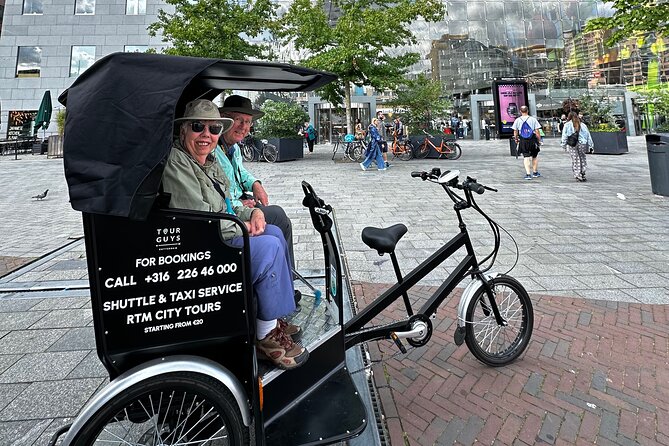
Rotterdam on wheels is a smart shortcut. This private pedicab/rickshaw ride lets you set the pace while a local guide connects the city’s modern shape to what happened in the 20th century.
I love two things most: the customizable itinerary based on your timing, and the way the guide turns each stop into a clear story you can actually remember.
One drawback to weigh: you’re on a fixed route with set photo and sight stops, so if you want long, slow time inside museums, you’ll need to pick your priorities.
In This Review
- Key highlights worth planning around
- A private pedicab orientation that matches your pace
- Pickup that actually helps, especially for cruise days
- How the guide connects Rotterdam’s layers in plain English
- Rotterdam Centraal Station: from scattered stations to one hub
- Neues Delftse Poort and the 2011 City Initiative: old gate, hard history, new ideas
- City Hall Rotterdam and the Meent: survival, then reinvention
- Grote of Sint-Laurenskerk: the medieval remnant that still feels big
- Markthal and the cube houses: modern Rotterdam with a human twist
- Comfort, photos, and the practical stuff that keeps the ride fun
- Price value check: what you’re actually buying for $150.18 per group
- Should you book this private Rotterdam pedicab tour?
- FAQ
- How many people can join this private pedicab/rickshaw tour?
- How long is the tour, and what kinds of stops are included?
- Is hotel or cruise port pickup included?
- Are service animals allowed?
- Is there a weight limit for passengers?
- What is the cancellation rule if the weather is bad?
Key highlights worth planning around
- Hotel or cruise port pickup makes the start feel easy, not stressful
- Up to 2 people means you get a true private experience, not a group cattle car
- WWII to modern design: you’ll see Rotterdam’s layers through stations, halls, markets, and housing experiments
- Includes timed stops that work well for short visits (about 1 to 1.5 hours)
- Comfort extras like bottled water and snacks help you stay focused on the sights
- Service animals welcome, and the tour is designed so most people can participate
A private pedicab orientation that matches your pace
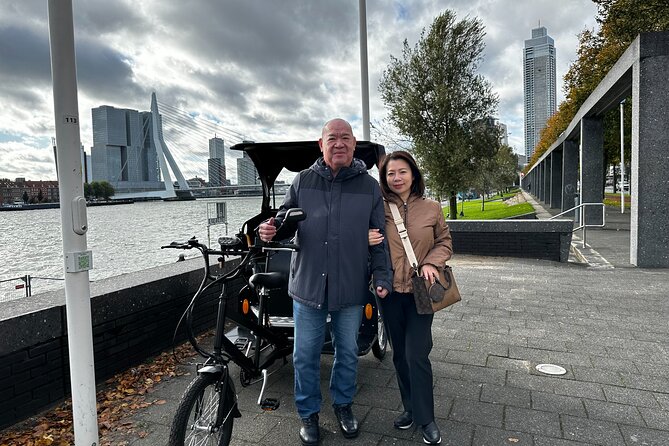
This tour is built for getting your bearings fast. Instead of walking until your feet revolt, you glide through Rotterdam on a pedicab or rickshaw style ride, which is perfect for a city that’s built around bike routes and quick connections between neighborhoods. Since it’s private for up to 2 people, you can ask for small adjustments without slowing down strangers.
The biggest value is how the guide brings the city into focus. Rotterdam can feel like a “new city” to visitors, but the stories make it make sense. You’ll hear why certain buildings survived, what got rebuilt, and why some designs were chosen to make people feel part of the urban plan, not trapped under it.
Timing matters here. A lot of the stops are short, so you’ll get a good hit of landmarks without losing the whole day. If you’re working with limited time, this is the kind of experience that helps you decide what to do next.
More Private Tours in Rotterdam

Pickup that actually helps, especially for cruise days
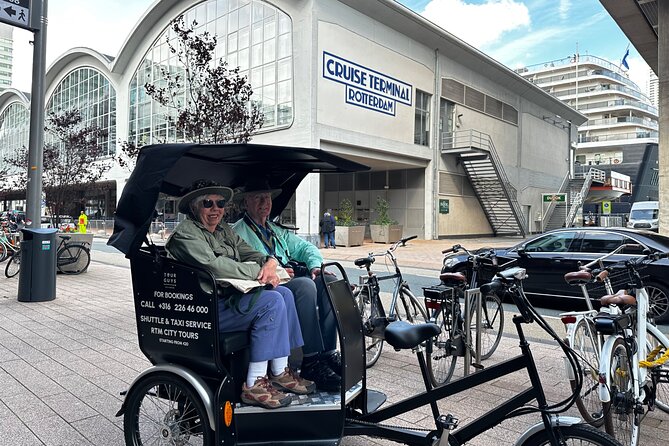
Pickup is offered, including a simple hotel meet-up if you’re staying in central Rotterdam. That’s your lowest-risk option, because you avoid the common “where exactly do we meet” scramble. You just indicate your hotel, and pickup is arranged from hotels in and around the center.
Cruise travelers get similar help. The tour notes that most sea cruises dock at the Rotterdam Cruise Terminal, while many river cruises dock at the Boompjeskade. If you want a specific meeting place, you can request it, and if you are not in a hotel in the center, you’ll be given suggested locations.
One practical note: on cruise days, the schedule depends on the ship being where it should be on time. If your ship runs late, it can affect the start. So I’d treat this as a “best case scenario” for timing and plan a bit of buffer if you have strict reboarding rules.
How the guide connects Rotterdam’s layers in plain English
Rotterdam’s story is not just architecture. It’s planning, rebuilding, and everyday life. A great part of this tour is that the explanations stay grounded, so you understand why things look the way they do, even if you are not a design expert.
You’ll go from transportation infrastructure to medieval remnants, then into 20th century reconstruction, and finally into bold modern experiments. The guide also tends to include quick “fun facts” style context, which makes the tour feel like you’re learning from someone who really lives here, not reading a scripted brochure.
You’ll also notice a common theme: Rotterdam keeps changing. Even places that survived had to serve a growing city. The guide’s job is to help you see the cause-and-effect. Why a station moved. Why a gate couldn’t stay where it was. Why a street changed identity. Why housing and public space were combined in a weird, clever way.
Rotterdam Centraal Station: from scattered stations to one hub
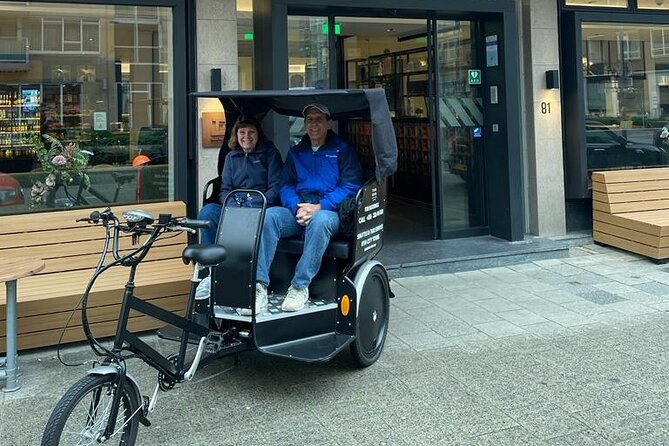
Your first major stop is Rotterdam Centraal Station. Before it existed in its current form, there were four stations around the center. That matters, because it sets up the idea that Rotterdam has always been about improving flow as the city grows.
The current central station opened in 1957 at its current location. Later, a full renovation began in 2004 and the completed result arrived in 2014. The reason for the big changes is simple: the old setup could not handle passenger volume anymore.
What to do with this stop, beyond looking at the station building: use it as your mental map. From here, you can understand why Rotterdam’s core feels like a connector city rather than a single historic “main street.” It also prepares you for the rest of the tour, which keeps showing how Rotterdam plans around movement.
This stop is short, about 10 minutes, and admission is free. That makes it a great anchor at the start, so your guide can build context before you move into the older layers.
Neues Delftse Poort and the 2011 City Initiative: old gate, hard history, new ideas
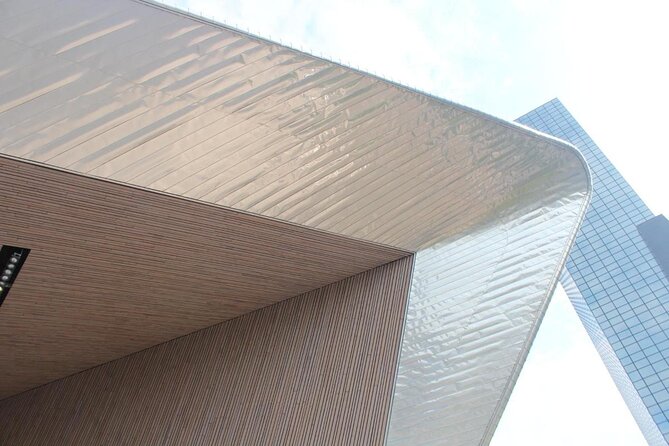
Next up is Nieuwe Delftse Poort, one of the most interesting “you have to know the story” spots. Rotterdam once had 10 city gates here. In the 1930s, the city wanted better traffic flow, and the gate became an obstacle to modern movement.
The decision was to move it about 100 meters. The demolition of the gate met resistance, which tells you people cared about the structure, not just the street layout. Then WWII hit. The gate was severely damaged during the Second World War bombardment. A year later, it was demolished because it could not be finished.
Here’s the clever part, and it’s exactly the kind of detail a good guide points out: some ornamental work was saved and built into the walls of buildings around Town Hall Square’s corner. So even if you never see the gate in one piece, you can still find hints of it in the surroundings.
There’s also a quick stop concept around Rotterdam’s city initiative work from 2011, when the municipality set aside 4 million to encourage innovation and citizen participation. For visitors, it’s a reminder that Rotterdam doesn’t only rebuild after damage. It also runs projects to improve life and keep the city evolving.
Also flying a pennant in Rotterdam
- Rotterdam: Harbor Sightseeing Cruise
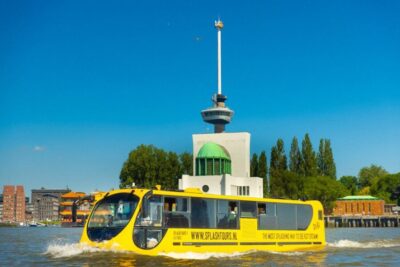
★ 4.3 · 7,599 reviews - Rotterdam: 1-Hour Sightseeing Splash Tour
★ 4.5 · 3,299 reviews - Rotterdam: Rotterdam Zoo Blijdorp Entry Ticket
★ 4.6 · 2,754 reviews - Rotterdam: Pancake Cruise
★ 4.4 · 1,986 reviews
City Hall Rotterdam and the Meent: survival, then reinvention
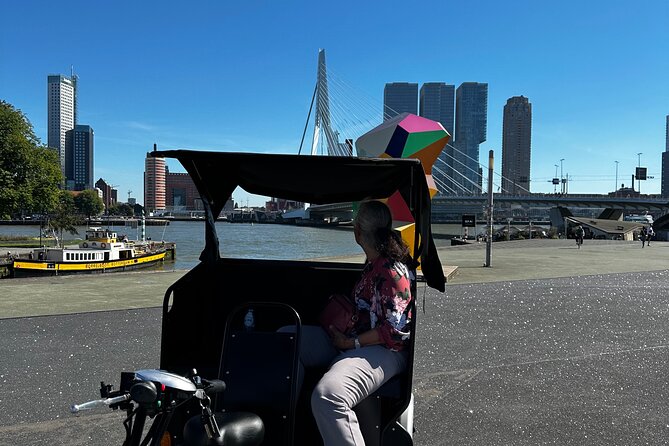
City Hall Rotterdam is a standout stop because it survived when many parts of the center did not. It was built between 1914 and 1920 by Henri Evers. Then, on May 14, 1940, much of the center was hit by bombing, but the town hall is one of the few buildings that made it through.
That survival is more than trivia. It’s the kind of anchor that helps you understand why Rotterdam’s center looks like a mix of eras. If you only see the newer buildings, you might assume everything was designed from scratch. Seeing City Hall helps you grasp what the city kept, what it lost, and how reconstruction had to respond to reality.
After that, the tour heads into the Meent, one of Rotterdam’s hotspot areas with cafés, eateries, and clothing shops. The story here is a full circle. In the 1990s, the Meent was more of an atmosphereless street with vacancy, with temporary employment and travel agencies dominating the scene.
One person’s name comes up in this narrative: Robin von Weiler, nicknamed Mr. Meent. The guide connects how his work shaped the street’s identity and helped it become the lively area it is today.
This is also a nice stop for photos, because the area is social and human-scale. It’s harder for a big landmark to feel “real,” but a street like the Meent does.
Grote of Sint-Laurenskerk: the medieval remnant that still feels big
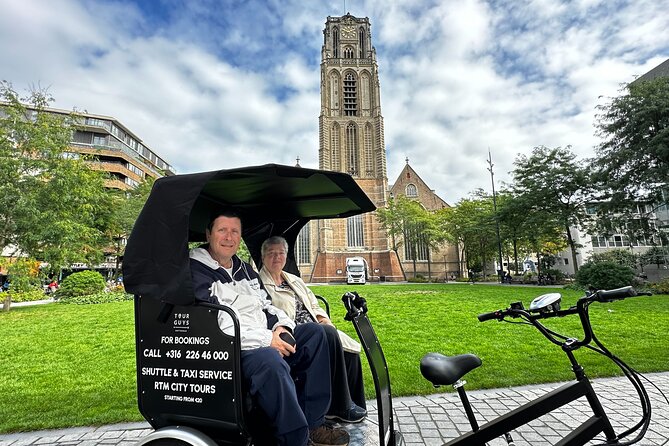
The Laurenskerk is the only remnant of Rotterdam’s medieval center. Even if you don’t know Gothic architecture, you’ll feel the significance once you’re near it. The church is described as a hybrid of a hall church and a cruciform basilica, with side towers lower than the main tower.
Construction dates are spread from 1449 to 1525. That means you’re looking at a building that took decades and reflects the long rhythm of older city life, before modern reconstruction reshaped the landscape around it.
This stop includes admission, around 10 minutes in the tour flow. Because time is limited, I’d focus on a quick sense of scale and layout rather than trying to absorb everything like a full museum visit. Think of this church as a “historical baseline.” Once you’ve seen it, the rest of the tour’s modern elements land differently.
Markthal and the cube houses: modern Rotterdam with a human twist
Markthal is a modern complex that looks like it was built to create a daily-life interior. It’s a covered market and food scene under an arch of apartments. The idea is that you get the convenience and variety of a market, but in a shaped, sheltered space that feels intentional rather than just functional.
This stop is about 30 minutes and admission is listed as free. That longer block gives you a chance to slow down, browse, and make your own food plans. It’s also a good place to stop and reset after earlier history-heavy stops.
Then you’ll finish with Kijk-Kubus Museum-house, also known as the cube houses. This is one of Rotterdam’s most recognizable design concepts because it turns housing into a public-space statement. The tour explains that in the 1970s architects wanted hospitable residential areas with resident participation, as a response to the grey reconstruction modernism after WWII.
Piet Blom is the key name here. He’s described as a structuralist influenced by Aldo van Eyck. The guidance behind the cubes ties to the idea that buildings should be built with human scale elements, even if the overall urban plan is large.
And the structural trick is the point: the building sits on columns so the space underneath can remain public. The guide also notes inspiration from Le Corbusier in the underlying approach. If you only see the cubes as quirky shapes, you miss the real reason they matter. They’re an attempt to reorganize how people share space.
Admission is included, and the stop runs about 15 minutes. That’s enough time to understand the concept and see why it became an icon.
Comfort, photos, and the practical stuff that keeps the ride fun
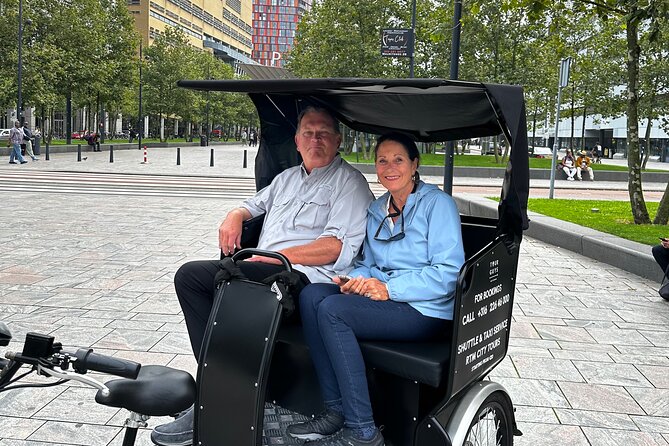
A pedicab is not just transportation. It changes how you take in a city. You get a slower, steadier viewpoint than a car, and you can stop for photos without the parking drama. That makes the whole tour feel more relaxed, even though the schedule is tight.
You’re also provided bottled water and snacks, which sounds small, but it keeps energy up during a one to one and a half hour window. Several guides in the experience’s history are praised for being energetic and stopping for pictures, so you can expect that photo-friendly rhythm.
Service animals are allowed, and the tour states it is near public transportation. There is also a safety weight limit: combined passengers must not exceed 200 kg or 440 lbs. If you’re traveling with someone who is close to that limit, it’s worth planning carefully.
Weather matters too. The experience requires good weather, and if it’s canceled due to poor weather, you’re offered a different date or a full refund. Rotterdam can be windy and changeable, so bring a jacket and plan for at least light rain protection.
Price value check: what you’re actually buying for $150.18 per group
The price is $150.18 per group, up to 2 people, for about 1 hour to 1.5 hours. That’s not “cheap,” but it’s not meant to be cheap either. It’s paying for two things that cost real money in a small city: a private guide and private pedicab transportation.
Where it becomes good value is when your time is limited. If you only have a few hours, you need a plan that compresses orientation, history context, and photo stops into one outing. The tour does that with short, meaningful segments rather than long, wandering gaps.
It also helps that pickup is included. In a busy port or central hotel situation, not paying extra for a taxi to meet a guide or to reposition at the end can make a big difference in real-world cost.
If you’re traveling with two people, you basically split the cost. If you’re traveling solo, you might compare it to the price of private alternatives, but here you still get a true private experience and control over your pace.
Also, the tour includes admissions at specific stops like Laurenskerk and Kijk-Kubus. Those inclusions help the tour feel complete, not like you’re constantly paying extra to access the best parts.
Should you book this private Rotterdam pedicab tour?
Book it if you want a smart introduction to Rotterdam with real city stories and a ride that lets you see a lot without wearing yourself out. It’s especially worth it if you have limited time, you’re arriving by cruise, or you want the kind of tour where you can ask for small changes and get a guide who adapts.
Skip it or think twice if you want a long, deep museum day or if your schedule is ultra strict with no flexibility. Since the experience is weather-dependent and follows a set flow of stops, you might feel constrained if your priority is slow, independent exploration.
If you do book, my advice is to plan your next moves right after. Use Markthal for a meal idea, use Laurenskerk and City Hall as your “then versus now” anchors, and use the cube houses as your “design and people” lens. That way, the tour is not just a ride. It becomes the brain-friendly start of the rest of your Rotterdam day.
FAQ
How many people can join this private pedicab/rickshaw tour?
The tour is private and priced per group for up to 2 people.
How long is the tour, and what kinds of stops are included?
The tour runs approximately 1 hour to 1 hour 30 minutes. It includes multiple short stops around central Rotterdam, including Rotterdam Centraal Station, Nieuwe Delftse Poort, City Hall Rotterdam, Laurenskerk, Markthal, and the Kijk-Kubus Museum-house.
Is hotel or cruise port pickup included?
Yes. Traveler pickup and drop-off are offered. Pickup is available from hotels in and around central Rotterdam, and guides can also pick up at common cruise docking locations (Rotterdam Cruise Terminal for most sea cruises, Boompjeskade for many river cruises).
Are service animals allowed?
Yes. Service animals are allowed.
Is there a weight limit for passengers?
Yes. For safety reasons, the combined passengers weight must not exceed 200 kg / 440 lbs.
What is the cancellation rule if the weather is bad?
The experience requires good weather. If it is canceled due to poor weather, you’ll be offered a different date or a full refund. You can also cancel up to 24 hours in advance for a full refund.
Latest to arrive along the quays of Rotterdam

Rotterdam Tours & Experiences, compared.


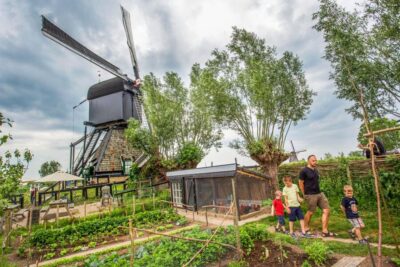
Kinderdijk UNESCO World Heritage Entry Ticket
Read our review →
Browse the lists this tour appears in