
Reviewed · RED LIGHT DISTRICT WALKS
Exclusive Amsterdam Red Light District tour with a drink
Red lights, explained in plain human terms. This exclusive Amsterdam Red Light District stroll gives you context for what you are seeing, and my guide Catherine kept the stories grounded and easy to follow. I especially loved how Catherine handled the subject with care, and how De Wallen turned from a stereotype into a real neighborhood with layers you can actually spot.
Another reason I liked this tour: you do not just stand outside windows. You walk past places with names and backstories, then finish with a drink in a proper local stop, The Ape (Int Aepjen). That combo of street-level history plus a warm pause is a smart way to leave the area feeling more informed, not just more entertained.
The main consideration is that the Red Light District is still the Red Light District. If crowds feel stressful or you have limited mobility, this may not be the right fit, because the walk is in a busy, older street layout.
In This Review
- Key things you will notice on this Amsterdam Red Light District walk
- Entering De Wallen with a guide, not a map app
- De Wallen streets and the landmarks you can actually place
- Dam Square and why Amsterdam’s buildings stand on wooden poles
- Waag, the old city gate, and how guilds shaped the square
- Pub The Ape (Int Aepjen) and the survival of old wood
- The smallest house, VOC trading, and a very long-lived tenant
- Condom-shop history, Chinatown edges, and the neighborhood beyond postcards
- The included drink at the local pub, and how to make it count
- Price of $98.33 for 2 hours, and what makes it feel fair
- Who this Amsterdam Red Light District tour suits best
- Should you book this Red Light District tour?
- FAQ
- How long is the Amsterdam Red Light District tour?
- Where is the meeting point?
- Does the tour include a drink?
- What does the price include?
- Is admission included for the stops?
- How many people are in the group?
- Is the ticket available on mobile?
- Is the tour suitable for limited mobility?
- Are service animals allowed?
- Is there free cancellation?
Key things you will notice on this Amsterdam Red Light District walk
- De Wallen guided stroll so you learn what you are looking at instead of guessing
- Dam Square stop with the wooden-pile story behind how Amsterdam is built
- Waag and city-gate history from the 1400s and its guild use
- The Ape (Int Aepjen) pub tied to old wooden building survival after the 1452 fire
- Smallest house and VOC storage history from the 1700s
- World’s first condom shop concept plus a broader look at the area, including Chinatown
Entering De Wallen with a guide, not a map app
The best part of this tour is that you start with a human guide who can explain the neighborhood in a way that makes sense on foot. You meet at ParkBee Parking NH Collection Amsterdam Barbizon Palace, Prins Hendrikkade 59, 1012 AD Amsterdam, then head out for about 2 hours of walking with a maximum group size of 16.
My favorite approach here is the tone. Catherine was informative and personable, and you get the feeling that the guide is aiming to educate you about the neighborhood’s history and the current situation, not to shock you. That matters, because Amsterdam’s Red Light District can feel like a maze if you are wandering on your own.
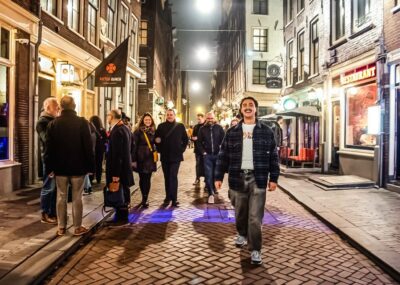
You will see narrow streets, and you will also get context for why this area is so old. It is part of the Old Town, so the tour naturally shifts from present-day storefronts to centuries of city life. Even on a busy night, the guide keeps moving with purpose, so you get bearings fast.
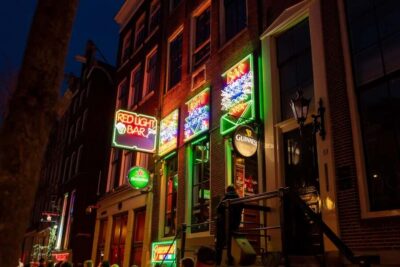
More lantern-lit windows explained:


De Wallen streets and the landmarks you can actually place
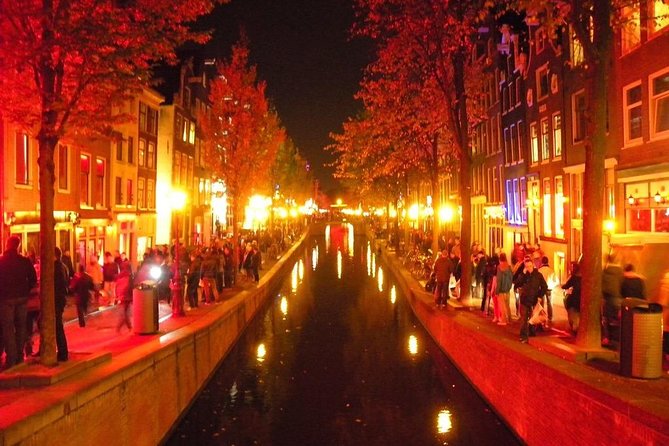
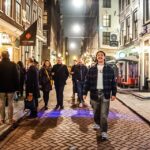
Once the walk starts, you are in the heart of it: De Wallen, Amsterdam’s Red Light District area. The streets are tight and the sights stack up, so a guide is useful for two reasons. First, you do not waste time trying to figure out what each landmark is. Second, you hear the neighborhood story as you pass it, which makes everything click.
During this part of the route, you will learn about the history of the district and the current situation, then make your way through key points of interest in the area. You also get references to things you might notice at street level, like the city’s narrowest street, and you pass through areas connected to the neighborhood’s older urban fabric.
One practical tip: wear comfortable shoes. This is a 2-hour walking tour, and the streets are the type where you will feel every step. If you are expecting a quick photo loop, adjust your mindset. This is more of a “walk with explanations” experience.
If you prefer low-pressure sightseeing, this works well because the guide leads the way and you are not constantly checking your phone. You will also be near public transportation, so it is easy to get back to your plans after the tour ends where you started.
Dam Square and why Amsterdam’s buildings stand on wooden poles
At one point, the tour pivots to Dam Square, and that is when Amsterdam reveals a different kind of fascination: how the city stays standing in marshy ground. Your guide shares why Amsterdam was built on wooden poles, because the soil includes a thick layer of fen and clay, with a sandy layer about 11 meters deep.
This is one of those facts that sounds abstract until you are walking around and looking at how the city’s older buildings behave. Amsterdam’s wooden foundation piles are driven deep into the clay, peat, and water until they reach that firmer sand layer. It is a practical engineering detail, but it gives you a new lens on the neighborhood.
You also get the connection back to the oldest parts of the city. The area you are touring is tied to the Old Town, which helps explain why there is so much history packed into a relatively small area. It is not just about the Red Light District as a concept. You are standing in a place that has been shaped by trade, construction, and city planning for a very long time.
One consideration: if you are looking for only nightlife-style explanations, you might find this engineering history shift a bit unexpected. I still think it’s valuable because it grounds the whole experience in what makes Amsterdam Amsterdam.
Waag, the old city gate, and how guilds shaped the square
Next comes the Waag, which used to be one of Amsterdam’s city gates. Your guide explains that it was built around the 1400s and that it is the second oldest building in Amsterdam. That alone is a good hook, but the bigger value is what the building did later.
After serving defensive purposes as part of the city wall system, the Waag became a place where guilds and craftsmen’s organizations set up. The craftsman community was situated within the Waag and around the square. In other words, this is a building that moved from protection to production, from military function to economic life.
For me, this stop is a great reminder that De Wallen is not isolated. It connects to the same urban currents that shaped the rest of central Amsterdam. You can look at the neighborhood and understand it as part of a working city, not only as a nightlife destination.
If your interest is architecture or city history, this is one of the stronger stops. If you are mostly here for atmosphere, it still helps. Even a short explanation about the Waag gives you something meaningful to hold onto when the street scenes feel chaotic.
Pub The Ape (Int Aepjen) and the survival of old wood
Then you hit a stop that adds warmth and authenticity: a visit connected with Pub The Ape, also known as Int Aepjen. The details here are what make the pub more than a quick pit stop. It is built around 1540 and is one of only two remaining wooden buildings left in Amsterdam.
Your guide ties this to a dramatic turning point in building rules. After the big fire in 1452, the government decided buildings should have brick facades. So when you hear the pub’s wood-building survival story, you realize you are looking at a rare physical survivor, not just a themed stop.
This is also where the experience starts to feel human. You go from narrow street sightseeing to a local pub environment. Even if you have questions or you just want a moment to reset, this is a natural place to breathe.
One practical note: pubs can feel busy in the evening. The group size is capped at 16, which helps, but you should still expect some crowding. Treat it as part of the Amsterdam night experience, not a problem.
Also flying a pennant in Amsterdam
- Amsterdam: Van Gogh Museum Ticket
★ 4.7 · 52,054 reviews - Amsterdam: Heineken Experience Ticket including 2 Drinks
★ 4.6 · 36,014 reviews - Amsterdam Classic Saloon Boat Cruise with Drinks and Cheese
★ 5.0 · 31,825 reviews - Amsterdam Luxury Canal Cruise + Unlimited Drinks & Bites option
★ 5.0 · 30,518 reviews
The smallest house, VOC trading, and a very long-lived tenant
Another highlight is the smallest house of Amsterdam, built around the 1700s. Your guide explains that it was first used as storage for the VOC trading company. Later on, people started living there for a very long time.
That “from storage to living space” transition is the kind of detail that changes how you interpret a tiny building. You are no longer just seeing a novelty house. You are seeing how commerce, space constraints, and daily life could overlap in the same footprint.
This is a good stop for anyone who likes “how did people actually live” history. It also fits the Red Light District setting in an interesting way, because it underlines the neighborhood’s density and practical use over time. Amsterdam has always been a city that makes tight spaces work.
A drawback to consider: because the house is small by definition, your viewing time may be brief. That is normal. Use the guide’s explanation to get the significance, then move on with the group.
Condom-shop history, Chinatown edges, and the neighborhood beyond postcards
Some tours treat the Red Light District like a one-note topic. This one gives you more angles. You will see references to the world’s first condom shop specialized for condoms, located here since 1987. The detail about customized condom sizes is mentioned as part of what the shop offers, which makes the stop feel anchored in real commerce rather than just rumor.
You also pass through the neighborhood connections that go beyond De Wallen itself. The tour includes a look toward Chinatown as part of what you see while walking the area. That matters because it nudges you to think about the Red Light District as part of Amsterdam’s larger mix of cultures and streetscapes.
And yes, you may notice the narrow street layout repeatedly. The guide points out the city’s narrowest street in context, which helps you understand why this area feels intense. The streets are physically narrow, so everything funnels into the same line of sight: shops, signage, people, and the surrounding city’s oldest patterns of construction.
If you are sensitive to adult-oriented storefronts, give yourself permission to look where the guide tells you to look, not where your curiosity drags you. You can still learn a lot while keeping your comfort level.
The included drink at the local pub, and how to make it count
This experience includes a drink of your choice as part of the tour. The point is not alcohol as a “reward,” it is a chance to slow down. After walking tight streets and absorbing a lot of information, you get a simple pause where you can process what you just learned.
In my view, the pub stop also functions as a cultural reset. Pub The Ape, Int Aepjen, is built around 1540 and tied to a notable architectural survival story. Sitting there makes the neighborhood feel less like a curated spectacle and more like a living corner of the city.
Use the time wisely. If your guide is chatty, ask a question about what you just saw, like why certain buildings changed after the 1452 fire or how the Waag shifted from a gate to a guild space. You will likely leave with a clearer mental map.
If you are choosing a drink, keep it simple. You are still on a walking tour, and you will end back at the meeting point. Plan for staying comfortable, not for turning the evening into a long pub crawl.
Price of $98.33 for 2 hours, and what makes it feel fair
At $98.33 per person for about 2 hours, this is not the cheapest way to see the Red Light District. But the value is in the guided format plus the included drink, and the fact that the group is small, up to 16.
Think about what you are paying for. You are paying for someone like Catherine who explains the neighborhood history and current situation while you walk. You are paying for context at multiple meaningful stops: Dam Square, the Waag, Pub The Ape, the smallest house, and even the condom shop detail since 1987. In Amsterdam, that kind of guided interpretation can save you hours of self-guided Googling and still leave you with more insight.
The drink inclusion also helps. You do not have to hunt for a place at the exact moment you are ready to sit down. When you add that to the quality of the storytelling, I think the price is easier to justify.
If you are traveling with a tight schedule or you really want a structured walk, I would treat this as good value. If you are the type who hates guided groups and prefers to wander freely, you might feel the cost more than the benefit.
Who this Amsterdam Red Light District tour suits best
This tour is best for you if you want a guided stroll that connects what you are seeing with history and city life. It works well if you are curious about Amsterdam’s Old Town and you like practical explanations, not just surface-level descriptions.
It is also a good choice if you appreciate specific landmarks. You will see the Waag, hear about the city’s wooden-pole building foundations, stop at landmarks tied to old trade history like VOC storage, and include a real pub built around 1540.
It may not be the right fit if you have limited mobility, because the tour is not recommended for that. It also may be a tough fit if you need a very neutral, low-sensory environment, since the Red Light District is inherently intense and can be busy.
One more timing reality. If closures happen during certain situations, some spots may be limited or not operating as usual. You might still get the main walking and history parts, but the exact feel of storefront stops can vary.
Should you book this Red Light District tour?
I would book it if you want to understand De Wallen as a real neighborhood. The combination of Catherine’s clearly delivered explanations, landmark stops like Dam Square, Waag, Pub The Ape (Int Aepjen), and the smallest house, plus the included drink, makes it more than a quick look.
I would skip it if you need a quiet outing, if adult subject matter will stress you out, or if mobility is an issue. In that case, a different kind of Amsterdam city walk might suit you better.
If you are on the fence, consider this simple rule. If you like guided storytelling that helps you place landmarks and understand why Amsterdam buildings, businesses, and streets developed the way they did, you will probably feel satisfied after those two hours.
FAQ
How long is the Amsterdam Red Light District tour?
It runs for about 2 hours.
Where is the meeting point?
The tour starts at ParkBee Parking NH Collection Amsterdam Barbizon Palace, Prins Hendrikkade 59, 1012 AD Amsterdam, Netherlands.
Does the tour include a drink?
Yes. You get a drink of your choice.
What does the price include?
It includes a local guide and a drink of your choice.
Is admission included for the stops?
Admission ticket is listed as free.
How many people are in the group?
The tour has a maximum of 16 travelers.
Is the ticket available on mobile?
Yes, the tour offers a mobile ticket.
Is the tour suitable for limited mobility?
It is not recommended for travelers with limited mobility.
Are service animals allowed?
Yes, service animals are allowed.
Is there free cancellation?
Yes, you can cancel for a full refund up to 24 hours in advance.
Latest to arrive along the quays of Amsterdam





Red Light District Walks, compared.
Amsterdam Red Light District & Coffee Shop Tour
Read our review →
Red Light District Pub Crawl with Unlimited Shots
Read our review →
Private Amsterdam Red Light District and Coffee Shop Tour
Read our review →
Browse the lists this tour appears in