
Reviewed · ROTTERDAM TOURS & EXPERIENCES
Rotterdam: Private Tour with Local Guide + Cube House visit
Rotterdam gets easier when someone narrates the details. This private, English-led walk through the Markthal area and the Old Harbour connects big architecture to daily life. I also liked the included look inside the Cube House, because it turns a photo-op into something you can actually picture. The main drawback to consider is time, it is only about 2 hours, so there is no long stop for museum-level wandering.
What makes this experience feel worth it is the way the guide links the stops. You see the city’s layers, from the Rotte River origins around Blaak to pre-war buildings that survived hard moments, and then right into Piet Blom’s playful 20th-century ideas. If you want a quick but meaningful orientation to Rotterdam’s “why,” this tour does that job well.
It is also structured for real people, not museum robots. You meet at Blaak station, move at an easy walking pace, and spend a short chunk of time at each highlight. Since it is private for your group (up to 15 people) with a mobile ticket, it is a simple plan for a first visit.
In This Review
- Key highlights you will actually notice
- Blaak station to the Markthal, why this opening works
- The Markthal, apartments above the food court
- City Hall on Coolsingel, pre-war Rotterdam in plain sight
- Grote of Sint-Laurenskerk, the tower that refused to disappear
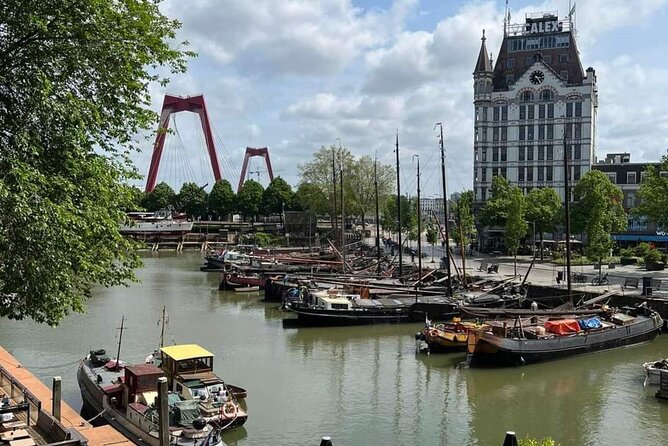
- Het Witte Huis, Europe’s oldest skyscraper with wartime scars
- Oude Haven, old ships, terraces, and Piet Blom’s influence
- Cube House museum-house, what makes the inside worth it
- Price and value, what $294.55 per group is buying you
- How to pace yourself during the 2 hour route
- The guide makes the difference, especially for architecture with stories
- Should you book this Rotterdam private tour?
Key highlights you will actually notice
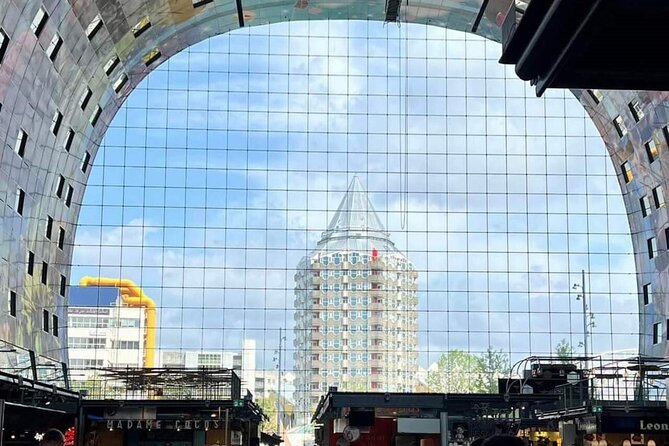
- Markthal on the inside, including the huge ceiling artwork and the sense of a city inside a building
- Blaak origins story, starting where Rotterdam began at the Rotte River dam area
- Coolsingel and pre-war Rotterdam, plus a stop at Rotterdam City Hall’s setting on the main boulevard
- Sint-Laurenskerk and Erasmus, with the church tower surviving the bombing and Erasmus being born here
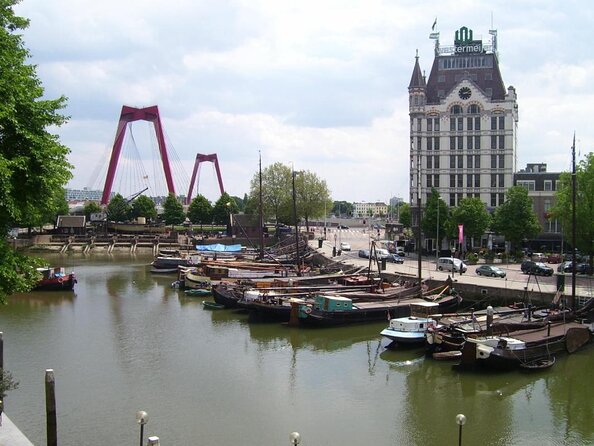
- Het Witte Huis and wartime clues, the oldest skyscraper of Europe (1898) and visible bullet-hole remnants
- Cube House interior visit, with the ticket built into the tour price so you can skip the planning
Blaak station to the Markthal, why this opening works
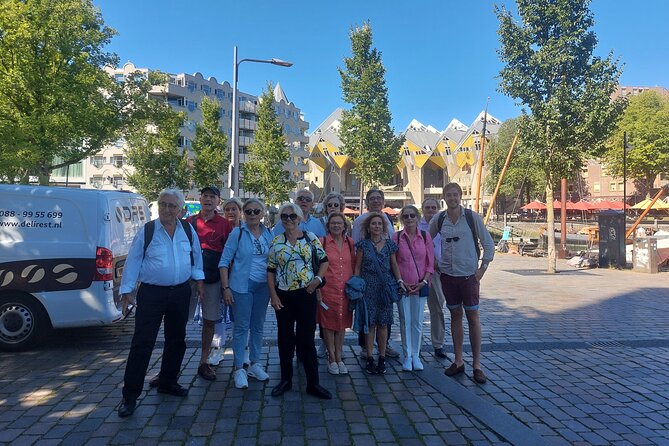
Most city tours jump straight to the most famous photo spot. This one starts where Rotterdam really takes shape, in the Blaak area. You begin near the place tied to Rotterdam’s origins, a dam in the river Rotte, and the area now feels like a working neighborhood rather than an isolated landmark zone. Even better, there is a market rhythm here, it happens twice per week, so you get the idea of a living city, not just sightseeing.
Meeting at Blaak station is practical. You arrive by public transport easily, and you are already in the thick of downtown Rotterdam. That matters because you spend your energy on walking and looking, not on figuring out where to start.
More Private Tours in Rotterdam



The Markthal, apartments above the food court
The Markthal is Rotterdam’s big modern icon, and it is worth seeing from the outside first, then getting inside. From the Blaak area, you walk into the Markthal Market Hall where two sides of the building are lined with apartments. That layout changes how you experience it. Instead of treating food like a stopover, you see it as part of daily living for people who live in the building.
Inside, the range of foods gives you a fast snapshot of Rotterdam’s international mix. The whole place feels like a meeting point, even when you are only there briefly. And then there is the ceiling artwork. You are meant to look up, because one of the biggest pieces of art on the planet sits above you, making the market feel like a designed space, not an accidental one.
A smart note for your visit: since this stop is relatively short, go in ready to scan. Look for the ceiling artwork first, then walk a slow circle so you get the apartment-on-top effect. If you only rush to one corner, you will miss the vertical story of the building.
City Hall on Coolsingel, pre-war Rotterdam in plain sight
After the Markthal, the walk heads toward Rotterdam City Hall on Coolsingel, known as the Champs-Élysées of Rotterdam. That comparison helps you understand the street’s role, it is a grand central axis rather than a side street. You also get a shift in mood from the market’s indoor energy to the open boulevard feel.
What you are looking at here is a rare survivor type. The town hall is described as one of the few pre-war buildings in the city. When a city talks about resilience, you usually hear big speeches. Here you see it in the architecture itself, because not every older structure made it.
This is also the kind of stop where a guide really earns their time. Even without going deep into offices or museums, you learn why certain buildings are treated as markers. That context makes the city feel more intentional, less random, even when you are just passing through.
Grote of Sint-Laurenskerk, the tower that refused to disappear
Close to the Markthal area stands the 14th-century church, Grote of Sint-Laurenskerk. The tower is the headline, because it miraculously survived the bombing of Rotterdam. That detail matters, because Rotterdam’s modern image is often tied to rebuilding stories, and the church becomes a physical reminder that something older lived through a catastrophe.
Today, the church is mostly used as an event location. That means it is not only a relic you stare at from a distance. If you see people setting up for something, it reinforces the idea that the building still plays an active role in city life.
You also get a strong personal connection through Erasmus, the famous figure born here. Rotterdam is proud of its thinkers as well as its builders, and tying Erasmus to the church makes the stop feel less like a generic church visit and more like a location with human roots.
Het Witte Huis, Europe’s oldest skyscraper with wartime scars
Next comes one of the most memorable “look closer” stops in the Old Harbour area: the White House, called Het Witte Huis. This building is described as the oldest skyscraper of Europe, dating from 1898. It is a big deal for Rotterdam because it shows that vertical ambition arrived early, long before modern glass towers took over city skylines everywhere.
Your guide will point out how to read the building like a document. One of the most striking elements is the hint of history in the facade, remnants of German bullet holes. Whether you notice them at a glance or only after your guide directs your eyes, this is exactly the kind of detail that turns a photo into understanding.
A practical tip: stand back for the full building silhouette first, then step in a bit to scan where the guide tells you to look. If you only zoom your phone camera from far away, you may miss the smaller traces that make the story real.
Also flying a pennant in Rotterdam
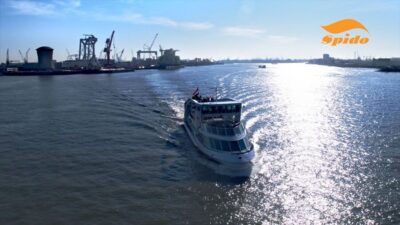
- Rotterdam: Harbor Sightseeing Cruise
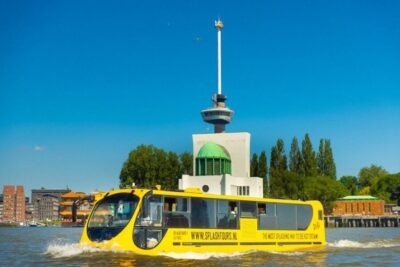
★ 4.3 · 7,599 reviews - Rotterdam: 1-Hour Sightseeing Splash Tour
★ 4.5 · 3,299 reviews - Rotterdam: Rotterdam Zoo Blijdorp Entry Ticket
★ 4.6 · 2,754 reviews - Rotterdam: Pancake Cruise
★ 4.4 · 1,986 reviews
Oude Haven, old ships, terraces, and Piet Blom’s influence
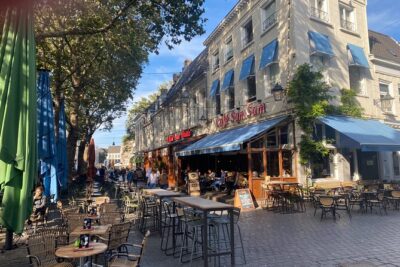
From Het Witte Huis, you move into Oude Haven, the Old Harbour area. This is where Rotterdam feels like it is enjoying itself. It is now a recreational area with terraces, so you are not just surrounded by architecture, you are also near everyday leisure.
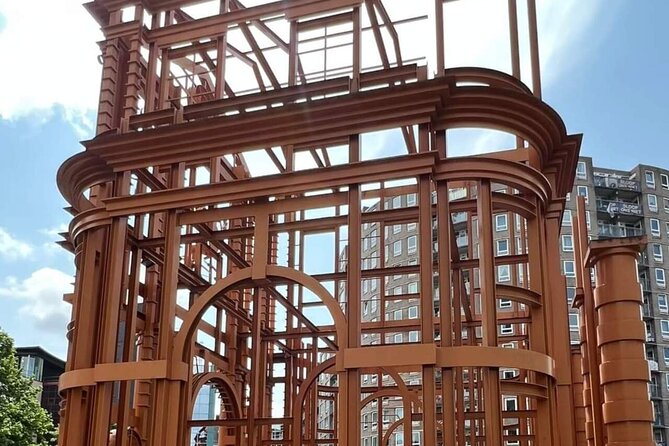
The stop has two visual themes. First, you see more Piet Blom architecture, the style that brought the Cubic Houses idea into the city’s identity. Second, you can spot old ships anchored here for restoration. That is important because it reminds you that Rotterdam’s waterfront culture did not vanish, it just shifted.
The tour also frames Oude Haven in time. Today, the real commercial port is located many kilometers to the west from here. So you are seeing the historic harbor district, not the current industrial heart. That distinction helps you avoid confusion, and it also helps you appreciate why this area feels like a hangout zone rather than a working port.
Cube House museum-house, what makes the inside worth it
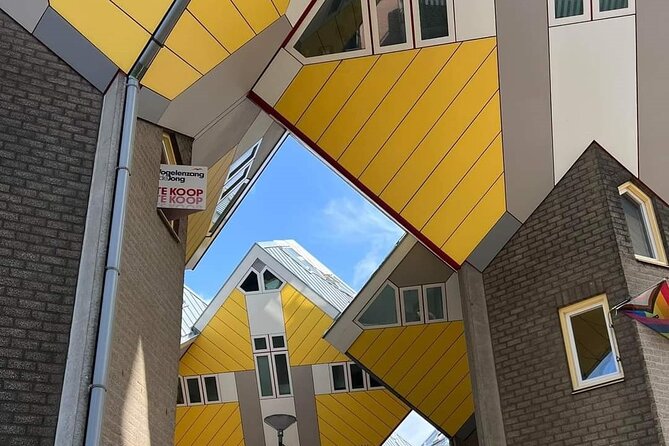
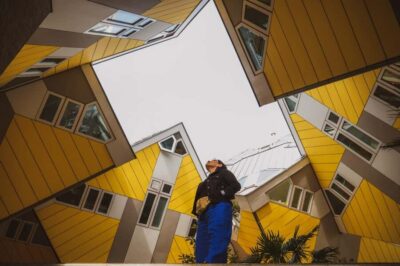
You likely already noticed the Cubic Houses from outside. They are hard to forget, and they are designed by Piet Blom, a key name in Rotterdam’s modern story. The concept is playful on the outside, but the timing is also part of the story: the idea comes from the 70s, and the Cubic Houses were built in the 80s. The design represents a way of creating a village inside a city, stacking human-scaled spaces within a larger urban framework.
Here is what makes the tour special at this point: you do not just look at them. You get to view one of the apartments from the inside, and the ticket price is included. That inclusion matters because it removes the planning friction. You already paid for the core experience, so you can focus on using the time well once you are inside.
When you step into the apartment view, do two things. First, take note of how the space feels compared to the exterior shapes. The angles and geometry can read as strange from the street, and inside they make more sense as lived space. Second, listen to your guide’s explanation of how the Cubic Houses idea aimed to change how people experience city living, not just where they live.
If you enjoy design that pushes against standard thinking, this is the highlight. If you prefer traditional interiors, it still works because it is a real apartment view, not a themed set.
Price and value, what $294.55 per group is buying you
At $294.55 per group, this is priced like a private experience rather than a mass group walking tour. The key detail is that the group size can be up to 15 people, so the per-group structure can make sense for families, colleagues, or small friend groups who want the same guide and the same route.
You are also paying for more than sightseeing. The tour includes a private guide, all fees and taxes, and the entry ticket to the Cubic House apartment view. Many of the other stops are free to enter, so the value comes from context: why the buildings matter, what survived, what changed, and what the city learned from its past.
The 2-hour duration also affects value. If you are short on time, it gives you a curated highlight loop without forcing you into a full day of indoor tickets. The tradeoff is depth. If you want long stays, this route is more for orientation than for slow, lingering study.
Overall, if you want Rotterdam’s architecture plus quick story context, the pricing feels reasonable for a private guide experience with a paid attraction included.
How to pace yourself during the 2 hour route
This tour works best with the right expectations. You will make several short stops, and the rhythm is designed to keep energy up while still giving you time to look carefully. Wear comfortable shoes, because you are walking through downtown areas between major landmarks.
At the Markthal and Cube House parts, you will get the most value by slowing your eyes down. For Markthal, that means looking up at the ceiling artwork and noticing the apartments framing the market hall. For Cube House, it means taking in the shape of the apartment so the concept of a village inside a city becomes physical, not theoretical.
Also, bring a camera, but do not only shoot. If your guide points out details like bullet holes at Het Witte Huis or Erasmus’s connection to the church, pause and let those facts land before moving on.
Finally, if you are traveling with teens or a mixed-age group, this format can work well. The pacing is flexible enough to keep everyone engaged, and the city’s mix of modern and historical sights makes it easier to maintain interest.
The guide makes the difference, especially for architecture with stories
A big part of why this tour performs well is the guide style. One guide named Fleur is described as informative and entertaining, with a knack for explaining architecture while also touching on political climate and social movements of the day. That combination is more than trivia. It helps you understand why a building exists, not just what it looks like.
Good guiding also changes how you feel about short stops. When you have context, a 10-minute glance can turn into a real memory. You also tend to notice details you would miss on your own, like the subtle marks connected to wartime history.
Because this is private, you can also adjust the pace for your group. That is especially helpful if you have someone who wants more time at a single stop, or someone who prefers to keep moving.
Should you book this Rotterdam private tour?
Book it if you want a fast introduction to Rotterdam that goes beyond the postcard version. You get a strong mix of modern architecture at the Markthal, surviving pre-war and wartime narratives around the church and Het Witte Huis, and a design-focused finish inside the Cube House. It is also a smart pick if you prefer a guide to connect the dots for you, because the stories are the value driver here.
Skip it if you want a slow, deep dive into just one area, like spending half a day at the Markthal food scene or doing multiple museum hours. This tour is built for orientation, not for long lingering.
If you are visiting for the first time and you want a compact plan that still feels meaningful, this is an easy yes.
Latest to arrive along the quays of Rotterdam


Rotterdam Tours & Experiences, compared.


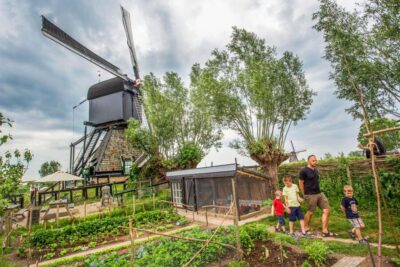
Kinderdijk UNESCO World Heritage Entry Ticket
Read our review →
Browse the lists this tour appears in