
Reviewed · WALKING TOURS
5 hrs Golden Age Amsterdam Private Walking Tour With Local Guide
Golden Age Amsterdam can be confusing, fast. This private walking tour with a local guide helps you get your bearings while you bounce from Centraal Station to Begijnhof, with stops that explain what you are actually looking at. I love how the route mixes major landmarks with smaller, story-rich corners like the Kleinste Huis van Amsterdam, and I like that the guide fills in the past so you are not relying on random plaques. The main drawback is simple, the schedule is tight, so if you want lots of long indoor time at museums, you will need to add extra activities on your own.
You meet at Amsterdam Centraal and the tour runs about 5 hours, with pickup offered if you set that up. Most stops are outside or have free admission, so you spend your time walking smart, not waiting in ticket lines for every single sight.
The big reason this tour gets such strong feedback is the guide. Many outings highlight Aleksandar, often called Aleks, for adapting his storytelling to kids and adults, staying flexible, and answering questions without rushing anyone.
In This Review
- Key things to love about this Golden Age Amsterdam tour
- Meet at Amsterdam Centraal, then walk the city’s building logic
- St. Nicholas Basilica and the Weeping Tower: faith, walls, and old departures
- Kleinste Huis van Amsterdam and the canal system you will actually care about
- The Waag: a customs house, a guild hub, and a medieval city gate vibe
- Ons’ Lieve Heer op Solder and Fo Guang Shan: secret worship and immigrant Amsterdam
- De Wallen with context: how to look without getting lost in the noise
- Dam Square to Royal power: Dam Square, National Monument, and the royal corner
- Begijnhof: a quiet break from the city’s contradictions
- Munt Tower, Rembrandt Monument, and the flower market break
- Sint Luciënsteeg and the Burgerweeshuis: stone gables and community care
- Anne Frank House and Westerkerk: a moving area with clear time limits
- Across the Amstel to Jodenbuurt: Blue Bridge, Skinny Bridge, and memory in the streets
- Price and value: what you pay for, and what you will pay extra
- Who should book this tour, and who should skip it
- Should you book the Golden Age Amsterdam Private Walking Tour?
- FAQ
- How many people are in the private group?
- Where does the tour start?
- How long is the walking tour?
- Are entrance fees included?
- Can I get tickets for the Anne Frank House during the tour?
- Is pickup offered, and can I cancel for a full refund?
Key things to love about this Golden Age Amsterdam tour
- A small private group (up to 4), so you can ask questions and adjust the pace
- Real city context, from neoclassical building details to canal maintenance and medieval walls
- Free sightseeing focus, with paid tickets only where it truly matters
- Smart coverage of big and awkward Amsterdam, including De Wallen with a clear, policy-aware walkthrough
- Anne Frank area included in the route, with time set aside, and ticket guidance up front
- Guide Aleksandar (Aleks) praised for languages and for keeping families engaged
Meet at Amsterdam Centraal, then walk the city’s building logic
Most first-time Amsterdam visitors start with the same problem, the city looks beautiful, but it is hard to know what you are seeing. The tour starts at Amsterdam Centraal, and that is a great choice. You get a quick explanation of the station’s 19th-century design, the Dutch neoclassical style, and the practical fact that the building sits on thousands of wooden poles.
This matters because Amsterdam is not just an aesthetic city, it is a constructed city. When you understand the poles, the canals, and the way the waterfront was engineered, the rest of the walk makes more sense. You will likely notice details you would otherwise miss, like why the city leans in places and why building on water is always a balancing act.
If you like structure, this tour delivers. It is paced in short chunks, so you get a steady flow of sights without the day feeling like one long march.
More Guided Walking Tours in Amsterdam


St. Nicholas Basilica and the Weeping Tower: faith, walls, and old departures
Next up is St. Nicholas Basilica, described as the biggest Catholic temple in the Netherlands, dating from the second half of the 19th century. Even if you are not there to study architecture, it is a strong waypoint. It shows the scale of religious buildings in a city that is often associated with trade, not temples.
Then you reach the Weeping Tower, once part of Amsterdam’s medieval city wall from the 15th century. The spot also connects to Henry Hudson, since this is tied to where Hudson set sail on his journey toward Northern America. You get the kind of link you can later use when you see maps, harbor areas, and Dutch exploration stories.
One practical note: the tour keeps stops around 10 to 15 minutes for these early points. That is ideal for orientation, but if a stop really grabs you, you may want to circle back later.
Kleinste Huis van Amsterdam and the canal system you will actually care about
One of the most memorable segments is Het Kleinste Huis van Amsterdam, the smallest house in Amsterdam at the canal Singel. You will see more than a cute photo-op here. The guide focuses on the meaning of grachten, the canals of Amsterdam, plus how they were used, why they exist, and the maintenance side most visitors never think about.
This is the kind of detail that changes how you walk the city. After this, the bridges feel less random. Narrow, tall, sometimes leaning houses stop looking like quirks and start looking like solutions shaped by land limits, building materials, and careful planning.
You also get trivia and practical curiosity about bridges and the way Amsterdam stacks vertical space. It is fun, and it is useful, because it helps you read the city as a whole instead of as separate postcards.
The Waag: a customs house, a guild hub, and a medieval city gate vibe
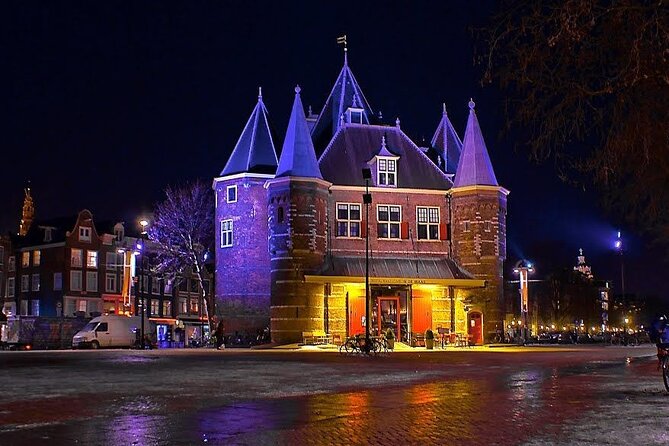
At De Waag, you get a lesson in how Amsterdam managed goods and power. The building served as the city’s weigh-building, basically a customs function, and it was also tied to guilds. It dates to the beginning of the 15th century and was one of the gates into the inner part of the city.
Even from outside, the story helps. Amsterdam’s Golden Age was not magic, it was trade, measurement, rules, and who had the authority to enforce them. When you understand the Waag’s role, you can connect it to other scenes you will see later in the walk, like Dam Square and the royal buildings.
This stop is short, about 15 minutes. That works for a walking tour, but if you love guild history, you might want extra time afterward.
Ons’ Lieve Heer op Solder and Fo Guang Shan: secret worship and immigrant Amsterdam
The tour then heads to Our Lord in the Attic Museum, Ons’ Lieve Heer op Solder. The admission is not included, but you get brief time at the site as part of the route. This is known as a secret church, restored into a museum experience today. It is one of those Amsterdam stories that explains why the city has layered identities.
Immediately after, you pass Fo Guang Shan, a Chinese traditional Buddhist temple in the heart of Amsterdam’s Chinatown. It is noted as the second biggest of its kind in Europe. Together, these stops highlight a pattern in the city: different communities shaped the built environment, and the city made room for new forms of worship over time.
If you do not want to pay extra for every paid stop, you can still enjoy the route, because many other sights are free. Just know the attic museum is one of the ones where you will likely have to decide based on your interests.
More Private Tours in Amsterdam
- Rijksmuseum Amsterdam Small-Group Tour with Private Upgrade
★ 4.5 · 1,547 reviews - Van Gogh Museum Tour Reserved Entry Semi Private
★ 5.0 · 1,437 reviews - Private Amsterdam Red Light District and Coffee Shop Tour
★ 5.0 · 763 reviews - Anne Frank and Jewish Quarter Amsterdam Private Walking Tour
★ 5.0 · 684 reviews
De Wallen with context: how to look without getting lost in the noise
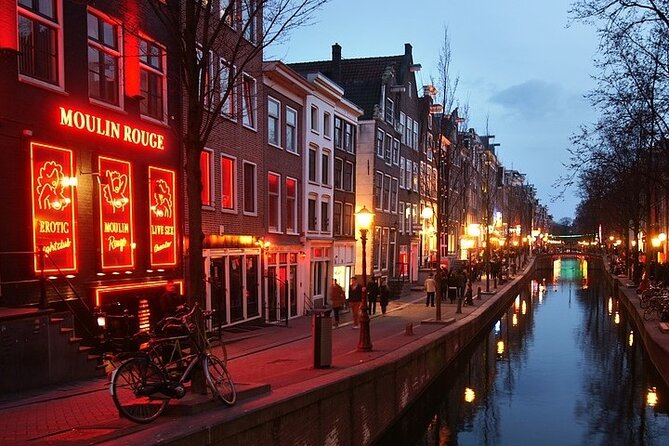
Then comes the Red Light District, De Wallen. The tour builds in about a 30-minute moderation-style discussion, covering prostitution and drug policy in the Netherlands. You get history, how things look today, and guidance on what is legal versus what is not, plus suggestions on how to enjoy the area responsibly.
I like this approach for first-time visitors. If you are curious but uncomfortable, you still get accurate framing. You are not left guessing at rumors or the loudest street-level details.
That said, this is still a sensitive area. The short time and the guided talk mean you will likely see the street scene, but you probably will not get a long, reflective wander. If you want to go slower through De Wallen, plan extra time after the tour.
Dam Square to Royal power: Dam Square, National Monument, and the royal corner
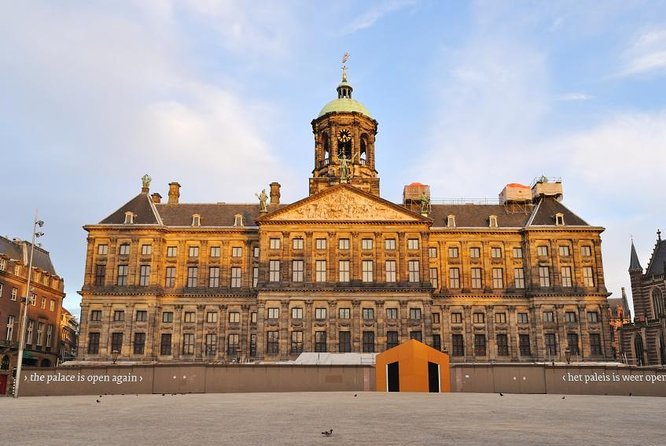
From De Wallen, the walk moves to Dam Square, the central and oldest square in Amsterdam, tied to the city’s birthplace. The route orients you by pointing out big surrounding landmarks like the Royal Palace, the New Church, the National Monument, and major public buildings around the square.
Next you visit the National Monument, a 22-meter tall remembrance structure from 1956, commemorating casualties of World War II and subsequent armed conflicts. Then you move to the Nieuwe Kerk, originally built in the 15th century, still used for weddings and royal family ceremonies.
The practical value here is timing and grouping. Without a guide, these spots can feel like random stops. With the route, they feel like one story about how Amsterdam honors memory and manages authority in public space.
Two paid entries show up here, Royal Palace Amsterdam and Nieuwe Kerk. The tour lists entrance fees, so budget accordingly if you want to go inside.
Begijnhof: a quiet break from the city’s contradictions

Begijnhof is the kind of place that makes Amsterdam feel human. You enter a hidden courtyard and memorial space for the Beguines, a semi-closed religious order similar to nuns. You also hear about another secret Catholic church connection, the oldest wooden house in Amsterdam, and the English Church.
The guide also shares a legend involving sister Cornelia Arens and a Miracle of Amsterdam story from 1345. Even if you do not track every detail, the overall effect is clear: this is Amsterdam at its most layered, peaceful, and oddly theatrical in its survival stories.
This stop is about 20 minutes, so it is long enough to feel the change in pace. It also serves as a relief valve after the heavier content near De Wallen and the remembrance spaces around Dam Square.
Munt Tower, Rembrandt Monument, and the flower market break
A quick move brings you to Munt Tower (Munttoren), a 15th-century structure linked to the meeting point of the river Amstel and the Singel canal. It also served as a gate to the medieval city and a place where coins were minted during the 17th century.
Then the tour heads to the Rembrandt Monument. You get a focus on Rembrandt van Rijn, plus interesting facts tied to his famous painting The Night Watch, including a 3D exposure referenced at the monument. The guide also shares personal-life trivia about Rembrandt that helps you connect the artist to the city rather than treating him like a name in a textbook.
After that, you hit the flower and garden accessories market, one of the biggest in the city. This is a great breather. You can take photos, look at tulip bulbs and other flowers, and grab ideas for what to buy if you are leaving Amsterdam with something that actually smells like the place.
If you are short on luggage space, treat it as browsing time. If you enjoy gardening or bulb collecting, it is one of the most fun ways to bring the city home.
Sint Luciënsteeg and the Burgerweeshuis: stone gables and community care
Next is Sint Luciënsteeg, tied to the City Orphanage, Burgerweeshuis, dating from 1580. You also get a street walk feel, with exposure to plenty of stone gables and stone tablets that refer to house identities over medieval times.
This is a stop I appreciate because it shifts you from famous individuals to the city’s everyday systems. Golden Age Amsterdam was not only about royal buildings and famous artists. It was also about care for vulnerable people and how communities documented identities through buildings.
The tour keeps it around 15 minutes, so you will see a lot in a short window. If you are a photo person, this is where you will want to slow down just a bit, because gables can turn into a scroll of details.
Anne Frank House and Westerkerk: a moving area with clear time limits
Anne Frank House is one of the tour’s most important stops, and it is also one of the most demanding for planning. Entrance is not included, and tickets can only be booked online. The data notes you must book at least 6 weeks in advance.
The tour sets about 15 minutes for the stop, which is ideal as a guided way to orient you before or after your timed entry. If you do not have the ticket ready, you might end up needing to decide on the fly, and that is stressful in this area. Do the ticket planning before you show up.
Nearby is Westerkerk, the third oldest church from 1631 after the South and North churches. It is known for a leaning tower, built for Protestant believers, and it is noted as a wedding place of Queen Beatrix. The tour also mentions a burial claim about Rembrandt van Rijn that is described as never precisely proven.
Westerkerk’s ticket is not included either. If you want to go inside, add that to your budget and your timeline. Even without entry, the area story gives context to what you see around Anne Frank House.
Across the Amstel to Jodenbuurt: Blue Bridge, Skinny Bridge, and memory in the streets
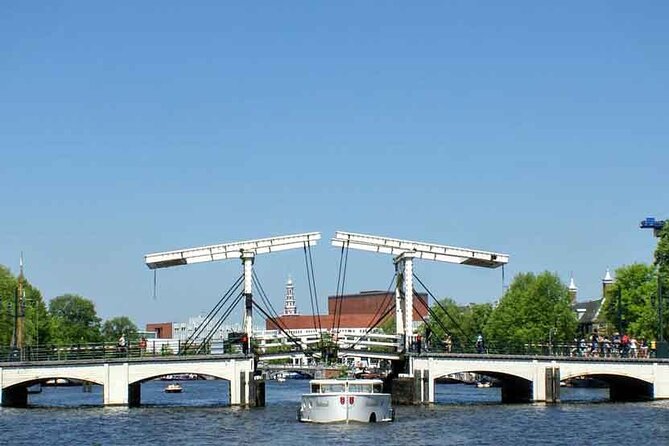
To wrap the walk’s emotional arc, you move toward the Amstel river. You get views over the Amstel and surrounding buildings, plus two named bridges: the Blue Bridge and the Skinny Bridge. These short river viewpoints can be a reset for the day, because they give you space to breathe and to see the city’s water lines from a human scale.
Then you reach Jodenbuurt, also called Plantage, the Jewish Quarter. The tour focuses on the area where many Jews lived from the late 16th century until World War II. It also references Holocaust monuments and memorials as part of the landscape.
This stop runs about 30 minutes, so it gives you time to slow down. It is also where a guided explanation can help you avoid turning the memorial landscape into just another photo stop.
Price and value: what you pay for, and what you will pay extra
The tour costs $540.69 per group for up to 4 people, about a 5-hour private walking experience with a guide. Split across four travelers, that can work out to roughly $135 per person before any attraction tickets. If you travel as a couple or solo, you might pay more per person, but you still get the benefit of a private route and the guide’s time.
Here is the trade-off that matters: many stops are free to view, but several major sites are not included. The tour lists entrance fees such as Royal Palace Amsterdam at €10 per person, Westerkerk at €7, Anne Frank House at €16, Nieuwe Kerk at €10, and Our Lord in the Attic Museum Ons’ Lieve Heer op Solder at €16.50. It also lists an Old Center fee of €13.50 and puts an overall entrance schedule in place for adults and students.
If you plan to go inside every paid stop, you should budget extra. If you focus on outside viewing and pick only the paid interiors that matter most to you, you can keep costs reasonable while still getting a full, meaningful route.
Also consider timing. This tour is booked quite far in advance on average, so waiting can cost you availability for your preferred day.
Who should book this tour, and who should skip it
Book it if you are a first-timer who wants structure. The mix of Centraal Station, canal-linked details like grachten and maintenance, major squares, quiet courtyards like Begijnhof, and the Anne Frank area makes this a smart “start here” day.
It is also a good fit for families and mixed ages because the guide is described as adjusting how he talks so kids and adults stay engaged. If you need flexibility, the guide’s reputation for being patient with requests and adapting pacing is a real advantage.
Skip it if you prefer long stays, deep museum time, or you want to customize the route heavily. The tour is designed to cover a lot in 5 hours, so you may feel a gentle push forward, even with a private group.
Should you book the Golden Age Amsterdam Private Walking Tour?
If you want an Amsterdam day that feels guided, practical, and story-driven, this is a strong choice. The biggest value is not just the list of stops, it is the way the guide connects them so the city makes sense as you walk.
I would book it if your goal is getting your bearings and understanding what you see, especially around Begijnhof, De Wallen with context, and the Anne Frank area. I would not book it if you already have every major ticket sorted and you want a slower, museum-heavy plan, because the tour’s strength is coverage, not extended indoor time.
FAQ
How many people are in the private group?
This tour has a maximum of 4 travelers.
Where does the tour start?
You meet at Amsterdam Centraal railway station, Stationsplein, 1012 AB Amsterdam, Netherlands.
How long is the walking tour?
The duration is approximately 5 hours.
Are entrance fees included?
Tour guide services are included, but entrance fees for specific sites are not included. The tour lists separate fees for Royal Palace Amsterdam, Westerkerk, Old Center, Anne Frank House, Nieuwe Kerk, and Ons’ Lieve Heer op Solder.
Can I get tickets for the Anne Frank House during the tour?
Anne Frank House tickets must be booked online, and the information notes at least 6 weeks in advance.
Is pickup offered, and can I cancel for a full refund?
Pickup is offered, and there is free cancellation. You can cancel up to 24 hours in advance for a full refund.
Gables on Foot
- Amsterdam: Anne Frank Guided Walking Tour in DE/EN/IT/ES★ 4.9 · 3,107 reviews
- Amsterdam: Anne Frank Guided Small Group Walking Tour★ 4.8 · 2,722 reviews
- Amsterdam: Cultural Highlights Walking Tour★ 4.9 · 2,629 reviews
- Amsterdam: Ganja Walking Tour★ 4.2 · 2,127 reviews
Latest to arrive along the quays of Amsterdam




Walking Tours, compared.
Amsterdam Anne Frank: Small-Group Walking Tour & Local Guide
Read our review →
Anne Frank’s Story – Guided Walking Tour through Amsterdam
Read our review →
Absolutely Amsterdam – the Essential Introductory Walking Tour
Read our review →
Anne Frank Guided Walking Tour in DE/EN/IT/ES
Read our review →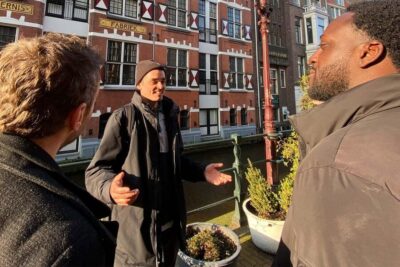

Anne Frank Walking Tour Amsterdam Including Jewish Cultural Quarter
Read our review →Browse the lists this tour appears in