
Amsterdam hits you fast, in good ways. This 2-hour private walk uses storytelling to explain how a small fishing village became a global power, and how Amsterdam’s idea of freedom shows up in everyday streets. You cover the landmarks most first-timers look for, then connect them into one clear picture of how the city works.
I love that it feels like a quick introduction to Amsterdam rather than a slow history lecture. My guide, Arie (spelling may vary), was very informative, and the pacing helped me get my bearings fast. I also like that the route ends at the Homomonument in the Westermarkt area, a short walk from the Anne Frank House and right by Westerchurch.
One possible drawback: the tour requires good weather, so if rain or poor conditions hit, you may need a different date or a refund.
In This Review
- Key points worth your time
- Why this Amsterdam DNA tour works in just two hours
- Dam Square and Damstraat: the city in one glance
- Beurs van Berlage and Damrak: money, trade, and the Red Light District edge
- Haarlemmersluis: the canal gateway and why bikes matter
- Singel and Torensluis: UNESCO canal-belt stories you can point to
- Grey Area: coffeeshop culture, explained on the route
- Keizersgracht (Emperor’s Canal): Dutch family life and everyday freedom
- Homomonument at Westermarkt: diversity made visible near Westerchurch
- Price of $138.44: what makes it good value
- Who this private Amsterdam walk fits best
- Tips to get the most out of the 2-hour route
- Should you book this tour?
- FAQ
- Where does the tour start and end?
- How long is the Amsterdam private walking tour?
- Is this tour private?
- Is pickup offered?
- What landmarks are included in the itinerary?
- Is there a mobile ticket?
- How much does it cost?
- What happens if the weather is bad?
- Is there free cancellation?
Key points worth your time
- A private format means it’s just your group on the walk.
- Dam Square to Homomonument is a smart center-to-center route that also sets you up for nearby sights.
- UNESCO canal belt stops include views and landmarks you can recognize right away.
- Coffeeshop culture is handled on-route, with a stop at Grey Area.
- Freedom and diversity themes come up naturally at the Red Light District edge and at the Homomonument.
- Mobile ticket plus free walking stops along the way keeps things simple.
Why this Amsterdam DNA tour works in just two hours
This tour is built to do one thing really well: give you Amsterdam’s “DNA” in a time budget that fits a first day, jet lag, or a trip where you want highlights without feeling rushed. At only about two hours, you’re not trying to cover everything. You’re learning enough to understand what you see next.
The big value is the way the route connects ideas, not just locations. You start with the city’s public heart at Dam Square, then move through places tied to commerce, canal culture, and the city’s famously liberal reputation. The tour’s theme is simple: Amsterdam became Amsterdam by combining practical trade, tolerance, and a strong sense of identity.
Because it’s private, you also get a more natural conversation than you do on crowded group tours. That matters on a walking route like this, where the guide can tailor emphasis based on what your group is most curious about.
More Guided Walking Tours in Amsterdam


Dam Square and Damstraat: the city in one glance
You begin at the National Monument on Dam, the classic meeting point in the absolute center. Dam Square is the kind of place where you can instantly feel the city’s energy. Even if you have no plan yet, standing here helps your brain place Amsterdam on the map.
From there, you walk into Damstraat, which is a practical intro to how Amsterdam’s central streets guide you toward major neighborhoods. The tour uses this early segment to set context, so later stops like the canal belt or the Homomonument do not feel random. They feel like the next chapters in the same story.
Practical tip: since you start here at 10:00 am, give yourself a little time to get oriented before you meet. This is the easiest point to be late to, because it’s also one of the busiest areas of the city.
Beurs van Berlage and Damrak: money, trade, and the Red Light District edge
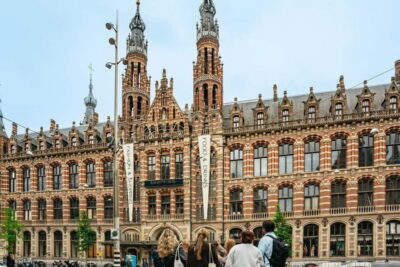
Next comes Beurs van Berlage, a landmark tied to Amsterdam’s financial story. This stop is one of the reasons I’d choose this tour over a purely “pretty canal photos” walk. It connects the city’s growth to ideas like trade, investment, and the rise of Amsterdam as a wealthy center.
Then you move to Damrak, which is positioned on the fringes of the Red Light District. That placement is important. You get the context without making the entire tour only about nightlife. The guide uses the area to explain Amsterdam’s reputation for freedom and tolerance, including how the city frames these topics.
This part of the walk can be emotionally different for different people. If you prefer a gentler introduction, pay attention to how your guide explains the culture and keep your questions focused on history and social rules. The tour is designed to be informational, not sensational.
Haarlemmersluis: the canal gateway and why bikes matter
At Haarlemmersluis, you get a canal-belt gateway moment, plus one of the tour’s fun, real-world themes: bike culture. Amsterdam’s reputation for bicycles is not just marketing. It shapes street design, daily routines, and how people move through the city.
This stop works because you see a view first, then get the explanation. By the time you move onward, you’re more likely to notice bike patterns instead of just seeing bikes as background.
If you’re planning to rent a bike later, this is the kind of stop that helps you understand why the city feels the way it does when you’re actually moving around. Even if you do not ride, you still get smarter about the city’s flow.
Singel and Torensluis: UNESCO canal-belt stories you can point to
The Singel stop puts you alongside one of Amsterdam’s most memorable visual features: canal-side architecture. The tour specifically calls out the Dancing Houses, which are a recognizable style of canal buildings. When you see them in person, you start to understand why the canal belt became a UNESCO heritage zone. It’s not only scenery. It’s a whole living design language.
After that, Torensluis connects the story to UNESCO canal belt creation. This is where you start to grasp that Amsterdam’s canals are not just a backdrop. They are part of how the city was planned, built, and preserved.
A small caution: canal belt stops can be popular photo moments. If the weather is good, expect some foot traffic. If you like clear views and quick questions, come prepared to pause and step aside when the group needs a moment.
More Private Tours in Amsterdam
- Rijksmuseum Amsterdam Small-Group Tour with Private Upgrade
★ 4.5 · 1,547 reviews - Van Gogh Museum Tour Reserved Entry Semi Private
★ 5.0 · 1,437 reviews - Private Amsterdam Red Light District and Coffee Shop Tour
★ 5.0 · 763 reviews - Anne Frank and Jewish Quarter Amsterdam Private Walking Tour
★ 5.0 · 684 reviews
Grey Area: coffeeshop culture, explained on the route
One of the tour’s most distinctive elements is the stop by Grey Area, a named coffeeshop referenced directly in the route. The tour uses this as a doorway to explain Amsterdam’s coffeeshop culture in practical terms.
This is valuable even if you do not plan to buy anything. Knowing how the city talks about rules and expectations helps you avoid confusion later, especially if you’re curious but unsure what is appropriate.
Keep expectations realistic: this is a walking tour, so the coffeeshop stop is not a long food-and-drink experience. It’s more like a guided point of context. You get enough understanding to navigate your next steps without needing guesswork.
Keizersgracht (Emperor’s Canal): Dutch family life and everyday freedom
At Emperor’s Canal, the guide shifts to how Dutch culture shows up in family dynamics, not only laws or landmarks. The tour mentions Dutch kids being named the happiest in the world by UNICEF in 2017. That detail is used to frame a bigger idea: Amsterdam’s freedom is not only about nightlife or headline topics. It shows up in how daily life is arranged and supported.
This stop is one reason the itinerary feels balanced. After the earlier stops tied to reputation and commerce, you get a calmer canal moment with a different angle on what makes Amsterdam “Amsterdam.”
If your interest leans toward culture rather than monuments, this is likely one of your favorites. You leave with a sense of the city’s mindset, not just its architecture.
Homomonument at Westermarkt: diversity made visible near Westerchurch
The final stop is the Homomonument, also known as the Gay Monument. This is where the tour’s theme lands hardest: live and let live, diversity, and Amsterdam’s identity as a city that tries to protect differences.
The location also gives you an immediate next-sight advantage. The tour ends at Homomonument, and the route notes it’s about a two-minute walk from the Anne Frank House and by Westerchurch. That means your walking momentum does not disappear when the tour ends. You can keep exploring without backtracking.
This ending also works emotionally. After canal views, bike culture, and coffeeshop context, you finish somewhere that connects the city’s reputation to something tangible. It feels less like a lecture and more like a place you can stand with and think about.
Price of $138.44: what makes it good value
At $138.44 per person for a private two-hour walk, this is not the cheapest option you’ll find. But it may be a good value if you care about two things: (1) a guide who can connect the dots and (2) a route that covers major Amsterdam themes without forcing you onto a long day schedule.
Here’s what you’re paying for, based on what’s included in the experience:
- A private format, so only your group participates.
- A focused route that hits major center landmarks and the canal belt.
- Admission tickets are listed as free for the stops, so you are not paying extra per location.
- A named coffeeshop stop at Grey Area, which is harder to get context on without local guidance.
- A mobile ticket, which helps with day-of simplicity.
- Pickup is offered, which can save time if you’re staying somewhere convenient.
For first-timers, the biggest “value” is mental. You finish the tour with a clearer idea of what you’re seeing later. That makes museum stops and neighborhood wandering easier, because your brain has a framework.
Who this private Amsterdam walk fits best
This tour makes the most sense if you:
- Want a quick introduction that you can build on the rest of your trip.
- Prefer a guided story that ties together different sides of the city.
- Like walking but do not want to plan routes between disconnected neighborhoods.
- Would rather ask questions in a private setting than compete for attention in a crowd.
It also helps that the tour lists “most travelers can participate,” and service animals are allowed. That suggests the route is designed for broad suitability, though of course you should still consider your own comfort with walking for roughly two hours.
Tips to get the most out of the 2-hour route
If you want this tour to feel like a sharp start rather than a blur, plan around three things: timing, curiosity, and pacing.
First, be on time. Starting at 10:00 am at the National Monument Dam is a good anchor, but delays can shorten your time on each stop.
Second, decide what you care about before you start. If you’re mainly interested in canals and architecture, ask follow-up questions at Singel and Torensluis. If your interest is culture and social life, steer questions toward the Homomonument and the Emperor’s Canal segment.
Third, match your pace to the route. The itinerary is designed with short stop times, around 10 to 15 minutes at each location. That means you should expect quick, clear explanations, not long standalone museum moments.
Should you book this tour?
If your goal is to understand Amsterdam beyond surface-level photos, I think this is a strong choice. The route covers major anchors, and the guide connects them into one message about freedom, identity, and the city’s path from fishing village to powerhouse.
Book it if you like guided storytelling, want a private format, and can commit to good weather. Skip it or be flexible if you prefer to travel without any exposure to areas near the Red Light District, or if you’d rather spend a full day on slower neighborhoods instead of a focused two-hour orientation.
FAQ
Where does the tour start and end?
The tour starts at National Monument Dam, 1012 JS Amsterdam. It ends at the Homomonument Westermarkt, 1016 DW Amsterdam, in the city center near Westerchurch.
How long is the Amsterdam private walking tour?
The duration is about 2 hours.
Is this tour private?
Yes. It is listed as a private tour/activity, and only your group will participate.
Is pickup offered?
Pickup is offered.
What landmarks are included in the itinerary?
The tour includes Dam Square and Damstraat, Beurs van Berlage, Damrak, Haarlemmersluis, Singel, Torensluis, Grey Area, Emperor’s Canal (Keizersgracht), and the Homomonument (Gay Monument).
Is there a mobile ticket?
Yes. A mobile ticket is listed as a feature.
How much does it cost?
The price is $138.44 per person.
What happens if the weather is bad?
The experience requires good weather. If it’s canceled due to poor weather, you’ll be offered a different date or a full refund.
Is there free cancellation?
Yes, cancellation is free up to 24 hours in advance for a full refund. If you cancel less than 24 hours before the start time, you will not receive a refund.
Gables on Foot
- Amsterdam: Anne Frank Guided Walking Tour in DE/EN/IT/ES★ 4.9 · 3,107 reviews
- Amsterdam: Anne Frank Guided Small Group Walking Tour★ 4.8 · 2,722 reviews
- Amsterdam: Cultural Highlights Walking Tour★ 4.9 · 2,629 reviews
- Amsterdam: Ganja Walking Tour★ 4.2 · 2,127 reviews
Latest to arrive along the quays of Amsterdam





Walking Tours, compared.
Amsterdam Anne Frank: Small-Group Walking Tour & Local Guide
Read our review →
Anne Frank’s Story – Guided Walking Tour through Amsterdam
Read our review →
Absolutely Amsterdam – the Essential Introductory Walking Tour
Read our review →
Anne Frank Guided Walking Tour in DE/EN/IT/ES
Read our review →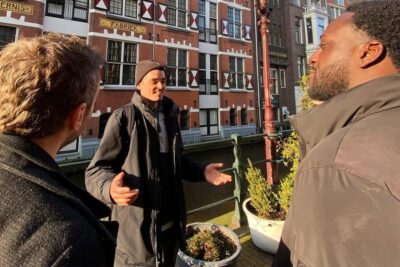

Anne Frank Walking Tour Amsterdam Including Jewish Cultural Quarter
Read our review →Browse the lists this tour appears in